What a Coach Actually Does, and Which Part Software Can Do

The Stronkr Founder Founder, Stronkr
7 min read
On this page
Do I need a personal trainer? It depends which part of the job you are missing. A coach does four separable things: corrects your technique, holds you accountable, manages your motivation, and decides what you lift next session. The first three need a human in the room who can see you, remember you, and notice when you go quiet. The fourth is arithmetic performed on data you already log.
Stronkr does the fourth. It does not do the other three and will not pretend otherwise, there is no human reviewing your sets, no certified trainer on the other end, no chat window. What exists is an engine that reads the RPE you rate each set and prescribes the load for your next session. If the part of coaching you actually lack is the programming step, that part can be automated. If it is the other three, hire a person.
Key takeaways
- A coach’s job splits into four parts. Only one of them, load prescription, is mechanical enough to hand to software.
- Stronkr does not see your bar path, does not know you skipped two weeks, and does not care whether you feel like training. No app does.
- Load prescription is the part self-coached lifters get wrong most often, and the part they spend the most unpaid time on.
- Your logged RPE sets the load for your next session. That is the one coaching job Stronkr does, and it is free.
What This Looks Like in Stronkr
The entire mechanism lives on one screen: the set screen inside an active session.
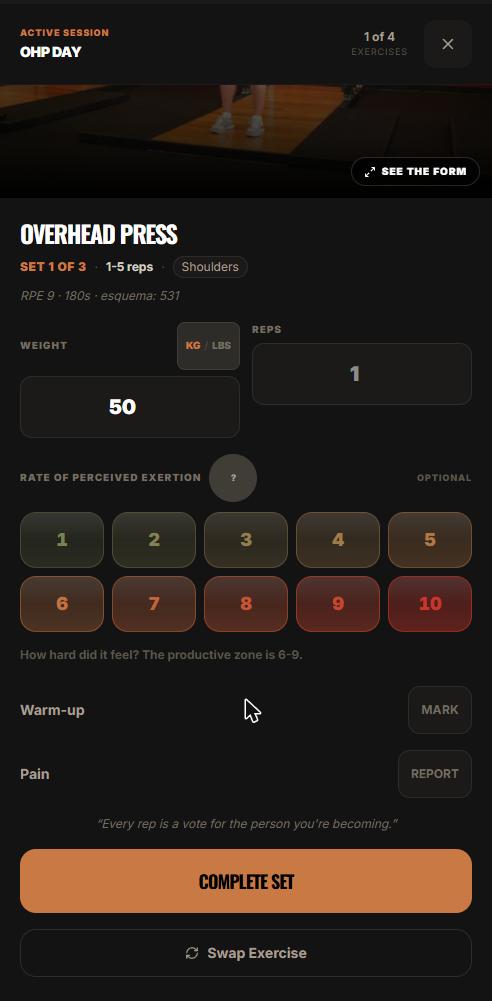
- Open today’s session. The header names the day, here, OHP DAY, then the exercise, Overhead Press, and where you are in it: Set 1 of 3.
- Enter the weight and the reps you actually completed. The KG/LBS toggle sits with the weight field, so you log whatever the plates say rather than converting in your head.
- Pick a number on the 1-10 RPE selector below, which runs green through red. The helper text underneath reads: “How hard did it feel? The productive zone is 6-9.” The
?next to the selector opens the in-app explainer if you want the definitions. - Use MARK to flag the set as a warm-up. Use REPORT if something hurt during it.
- Tap COMPLETE SET. The rating is now an input, not a diary entry.
Swap Exercise sits below the set if the movement is not going to work today. That is the whole interaction, four fields and a button, roughly the same effort as logging into any tracker, except the number you entered does something afterwards.
What it does afterwards is the point. The engine takes those ratings and returns a load for your next session, a target increase, or a deload when your ratings spike. If you want the mechanism in detail, how RPE auto-progression works walks through it end to end.
Which parts of a coach’s job actually need a human?
Three of the four. Not because software is young, but because the inputs those parts run on are not in your log.
Technique correction
A coach watches the rep where your bracing failed and tells you what to change before it becomes a pattern. That requires seeing you lift. No amount of weight-and-reps data reveals that your third rep drifted forward, and nothing in Stronkr claims to.
Accountability
Accountability is the knowledge that a specific person will notice you did not show up. An app can record that you did not train, but it cannot be disappointed in you. If missed sessions are your failure mode, a human obligation solves it and a notification does not.
Motivation
Motivation is a relationship. A good coach knows what you respond to and when to push back on your own bad ideas. Software has no read on your week, your job, or the argument you had before driving to the gym.
Three of the four coaching jobs need someone who can see you. Only one of them runs on numbers you already write down.
Why is load prescription the part software can do?
Because it is the only part whose entire input set is already in your log. Load prescription asks one question: given what you lifted and how hard it was, what should be on the bar next session? Both inputs are numbers you record anyway, the weight, the reps, and a rating of proximity to failure.
That last input is the one most trackers never collect, which is why they can archive your training but never prescribe from it. Rating a set by reps in reserve is established practice, not an invention: Helms ER, et al. (2016), in the Strength and Conditioning Journal, set out how to apply a repetitions-in-reserve RPE scale to resistance training. Stronkr implements that idea rather than improvising around it.
There is nothing subtle about the arithmetic once the rating exists. Ratings that sit in the productive range mean the load has room to move. Ratings that spike mean it does not, and the honest answer is a deload rather than another five pounds. A coach applies that logic between sessions. So can a rule.
What do self-coached lifters get wrong about picking loads?
They are late in both directions. Most people running their own programming add weight on a fixed schedule that ignores how the last session actually went, then hold that load two weeks past the point where the ratings were screaming, then deload only after a genuine miss.
The other failure is quieter and more common in the profile this is written for: the lifter who does it correctly, but does it manually. You already know what to do. You do it at 6am in a spreadsheet next to a tracker that recorded everything and decided nothing. That is not a knowledge gap, it is an unpaid job, the one the spreadsheet tax is about.
Deload timing is where the cost shows up most clearly. Deciding to back off is easy to defer when the only evidence is a vague sense that things feel heavy, which is why deciding when to deload without guessing matters more than any single load increase.
Stronkr’s progression engine is on the free tier, so testing this against your own numbers costs nothing but a session or two of honest ratings.
Is Stronkr a replacement for a personal trainer?
No, and framing it that way sells you something that does not exist. It replaces one function of one. If you are paying a coach primarily to send you a weekly load sheet, that is the function being automated here, and it is worth asking what you are getting for the rest of the fee.
An app that claims to replace a coach is lying about three quarters of the job. This one automates the quarter that is arithmetic.
If you are paying a coach to watch you squat, keep paying them. Those are different products that happen to share a word.
When you should still hire a coach
Hire one when you are changing something you cannot evaluate yourself. New competition lift, a technique fault you cannot feel, a return from injury where the risk of getting it wrong is real, or a genuine plateau that is not a programming problem. Also when accountability is the actual constraint, no software fixes that, and pretending otherwise wastes your money twice.
The two are not exclusive. Plenty of people run a coached block, then self-manage for six months, then go back. What has changed is that the self-managed stretch no longer requires you to be your own spreadsheet.
The question is not app versus coach. It is which of the four jobs you are currently doing badly.
What happens after you rate the set?
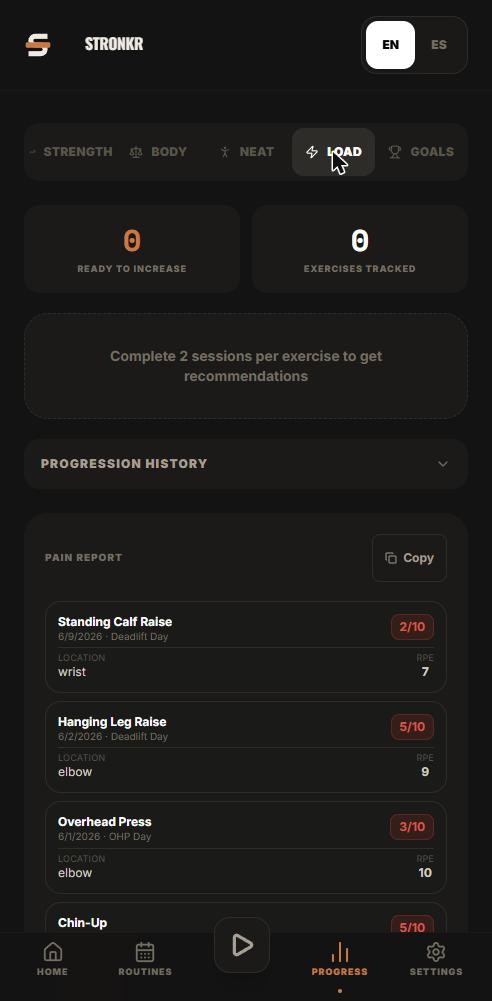
Your rating goes into the engine, and the load for your next session comes back out, an increase, a hold, or a deload. You see the result per exercise on the Progress, Load screen, which shows each lift’s progression history alongside a ready-to-increase recommendation. There is no interpretation step and no second system.
Accuracy of the input matters more than anything else here, which is why rating your sets accurately is the one skill worth practising. Rate honestly and the prescription is sound. Rate the way you wish the set had felt and you have built a spreadsheet that lies to you.
Start free at stronkr.com: unlimited routines, the routine generator, RPE auto-progression, ninety-day history, PR and volume tracking, offline, no credit card. If it turns out the programming step was the only part of coaching you were missing, you will know inside a month.
Try auto-regulated training
Stronkr reads your RPE after every set and adjusts next session’s load for you. No spreadsheets, no guessing.
Start training with StronkrFrequently asked questions
Do I need a personal trainer if I already use Stronkr?
If what you need is technique correction, accountability or motivation, yes, hire a person, because those require someone who can see you and remember you. If what you need is somebody to decide next session's load from what you actually lifted, Stronkr does that job without a human involved.
Does Stronkr give me a human coach or professional review?
No. Nobody reviews your training. There is no certified trainer, no messaging thread, and no human in the loop at any point. Stronkr is a progression engine: it reads the RPE you log on each set and prescribes the load for your next session. That is the entire claim.
Can an app correct my squat technique?
Not honestly. Technique correction needs a second pair of eyes on your bar path, your bracing and the rep that broke down. Stronkr never sees you lift. If your squat is the problem, buy a handful of in-person sessions or send video to a coach who does form review.
What exactly does Stronkr decide for me?
One thing: the load for your next session, per exercise. Your RPE ratings feed an algorithm that returns either a target increase, such as five pounds, or a deload of ten percent when your ratings spike. It is the arithmetic step you would otherwise do in a spreadsheet.
Is the progression engine behind a paywall?
No. RPE auto-progression sits on the free forever core, along with unlimited routines, the routine generator, ninety-day history, volume and PR tracking, and offline use. No credit card. PRO at $4.99 a month adds full history, personalized deloads and advanced analytics.
Keep reading
PRs You Didn't Have to Hunt For: Automatic Record Detection
Automatic pr tracking that runs off your normal sets: Stronkr detects 1RM, 5RM, volume and estimated 1RM records without you flagging a single thing.
One Session End to End: From Warm-Up to Next Week's Load
A full workout logging flow, set by set: open today's session, log weight, reps and RPE, mark warm-ups, report pain, and see what changes next session.
Progressive Overload Without a Spreadsheet
A progressive overload app should do the arithmetic, not just chart it. How Stronkr turns each set's RPE into the next session's load, no sheet needed.