The Spreadsheet Tax: What Your Tracker Still Makes You Do

The Stronkr Founder Founder, Stronkr
6 min read
On this page
You pay for a training app. You also keep a workout spreadsheet, and you open it on Sunday night or at 6am on the way to the gym, because the app knows what you lifted and the sheet decides what you lift next.
That gap is the spreadsheet tax. It is not a subscription line item, which is why nobody counts it. It is twenty minutes a week of arithmetic, a mental model of your own program you have to reload every time you touch it, and a second source of truth that quietly goes stale the week you travel.
The tax is invisible because it feels like diligence. Serious lifters keep sheets; that is the folklore. But the sheet is not evidence that you are serious. It is evidence that the tool you already pay for stopped one step before the useful part.
Key takeaways
- The tax is the decision work your tracker leaves on your desk: next week’s loads, which lifts to push, which to back off.
- It scales with experience. Novices do not pay it, because linear progression is trivial arithmetic.
- The sheet is a second source of truth, and second sources of truth drift.
- What closes it is not a better chart. It is an app that outputs a load instead of a graph.
What This Looks Like in Stronkr
Take your sheet column by column and look at where each one goes.
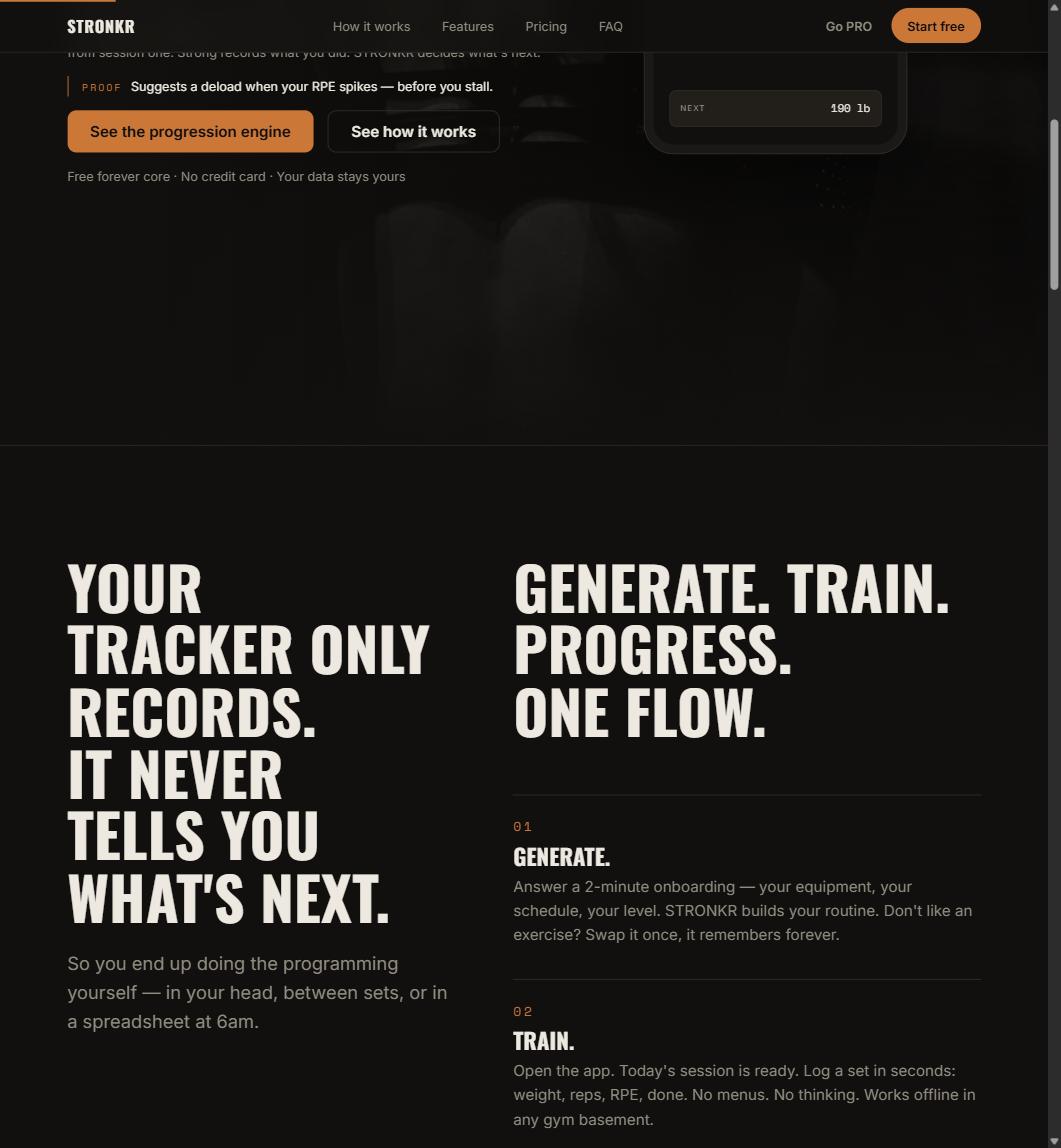
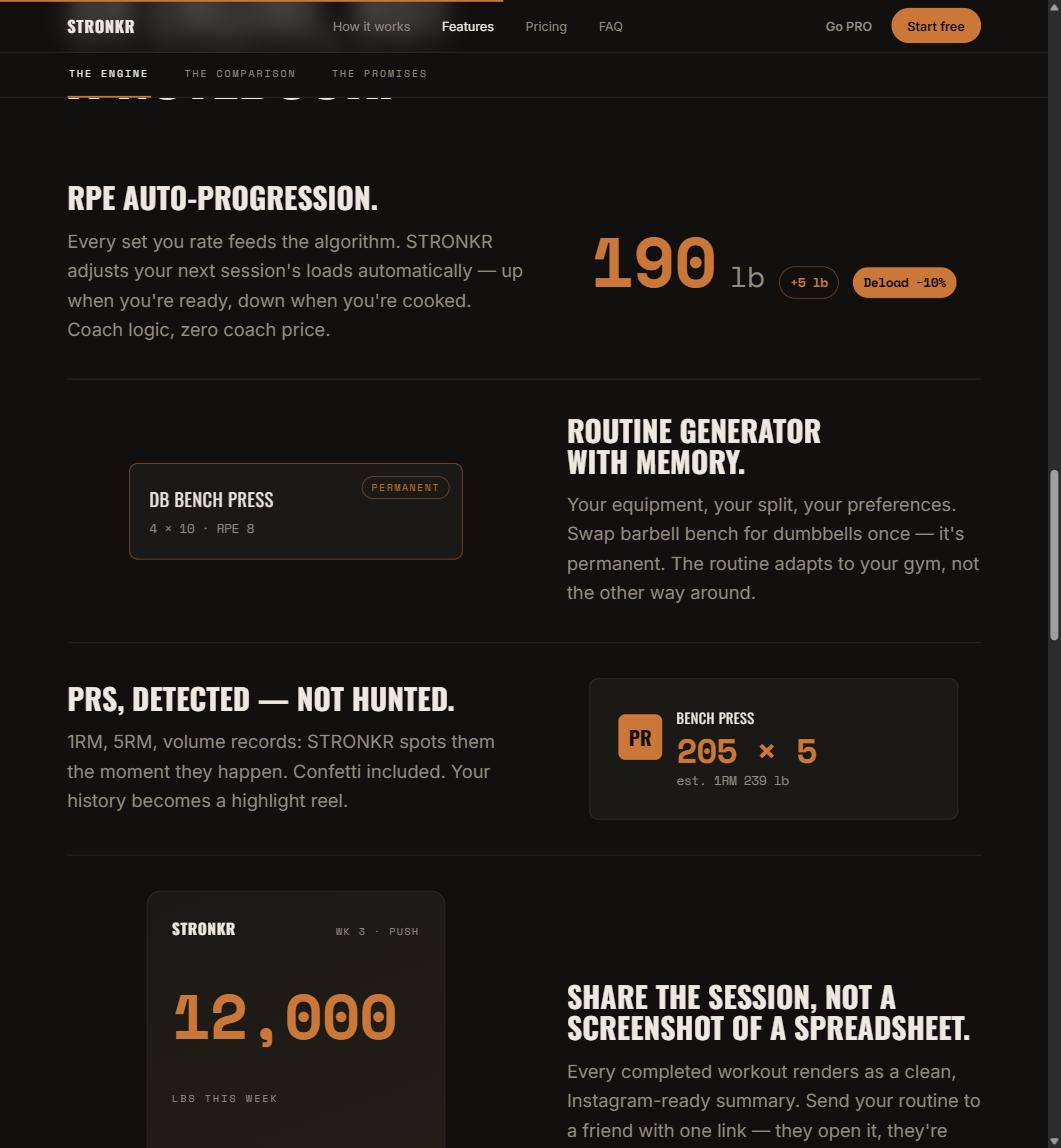
- Your “next week’s load” column becomes the app’s output. The homepage shows the shape of it directly: a NEXT 190 lb target, not a chart of what already happened.
- Your “how did it feel” note becomes the RPE selector on the set screen, 1 through 10, shaded green to red, under the weight and reps fields, with helper text reading “How hard did it feel? The productive zone is 6-9.”
- Your unit-conversion cell becomes the KG/LBS toggle that sits with the weight and reps fields, because plates in a hotel basement are rarely stamped in the unit your program is written in.
- Your “back off this block?” cell becomes
Deload -10%. The homepage PROOF line states it plainly: a deload suggested when your RPE spikes, before you stall. - Your tab-per-block structure becomes the three-step flow the product runs on: GENERATE, TRAIN, PROGRESS.
- Your Sunday-night maintenance window becomes one number per set, tapped while you are already standing at the rack.
The site has a block that states the premise without decoration: “YOUR TRACKER ONLY RECORDS. IT NEVER TELLS YOU WHAT’S NEXT.” That sentence is the entire reason your sheet exists.
What is the spreadsheet tax, concretely?
It is the residue of a tool that records but does not decide.
The line items
Retyping or exporting last session’s numbers. Applying whatever progression rule you settled on two years ago. Checking which lifts have stalled long enough to warrant a change. Rebuilding a block when a joint or a piece of equipment changes. Reconciling the sheet against the app when the two disagree, which they will.
Why it never appears on the invoice
Nobody bills you for it, so it does not compete with the app’s price in your head. But a tracker at five dollars a month plus twenty minutes a week of your own programming labour is not a five-dollar-a-month tool. It is a five-dollar-a-month archive with an unpaid analyst attached, and the analyst is you.
Your tracker is not overpriced. It is under-scoped.
Why does the sheet survive every app you try?
Because you have been evaluating apps on the wrong axis.
Logging was never the bottleneck
App reviews compare logging speed, chart design, exercise libraries, watch support. All real, none of them the reason the sheet is open. You do not keep a sheet because your app logs slowly. You keep it because the app has no opinion about Monday.
The decision layer has to live somewhere
At three to five years in, progression is no longer one rule applied uniformly. Bench is stalling, squat is still climbing, overhead press needs a back-off, and the schedule shifts because you are in a hotel for a week. That reasoning has to exist somewhere, and if the app declines to host it, it lands in a sheet. The category split behind this is the subject of workout tracker vs workout programmer.
If you would rather see the alternative than argue about it: the routine generator runs about two minutes of questions, equipment, schedule, experience level, and returns a routine with the progression already attached, at no cost and with no card.
What does the tax actually cost you?
More than the twenty minutes, which is the part people underestimate.
Drift
Two systems holding the same truth diverge. You log a substituted exercise in the app and forget to reflect it in the sheet. You compute Monday’s load from a session you later marked as a warm-up. Within a block, the sheet is subtly wrong and you are training off it anyway.
Latency
The sheet updates when you sit down at it. If you train Monday and open the sheet Wednesday, Tuesday’s decision was made from stale numbers or made in your head between sets. Neither is the plan you wrote.
Percentage math you cannot verify
Most sheets implement percentage-based progression off a 1RM you tested at some point. That number ages. Helms et al. (2018), in Frontiers in Physiology, compared RPE-based loading against percentage-1RM loading in periodized programs matched for sets and repetitions, the point being that there is more than one defensible way to assign a load, and yours should at least reflect what today actually cost you.
A spreadsheet is a snapshot of what you believed about your body the last time you opened it.
What has to be true for the sheet to close?
Three things, and only three.
The app has to collect effort, not just output
Weight and reps describe the set. They do not describe what it cost. Without an effort rating there is nothing to autoregulate from, which is why an app can hold four years of your data and still have no basis for a recommendation.
The app has to output a load
Not a chart, not a trend line, not a badge. A number for the next session. In Stronkr that resolves to a target increase such as +5 lb, or Deload -10%. The mechanism is covered in full in what RPE auto-progression is and how it sets your next load, and the principle it automates in progressive overload without a spreadsheet.
Nobody enjoys the sheet. They tolerate it because nothing else in the stack will make the call.
It has to be free enough to not become a second tax
Paying twice, once for the tracker you keep and once for the engine, is a poor trade, which is why the progression engine sits in the free tier rather than behind PRO. That commitment is written down, and why the free tier never shrinks covers what it does and does not promise.
Stronkr installs from the browser as a PWA, works offline, and asks for no credit card. Generate a routine at stronkr.com, run one week through it, and then check whether you opened the sheet on Sunday. That is the only test that matters here.
Try auto-regulated training
Stronkr reads your RPE after every set and adjusts next session’s load for you. No spreadsheets, no guessing.
Start training with StronkrFrequently asked questions
What is the spreadsheet tax?
It is the unpaid work left over after your tracker has done its job: exporting or retyping numbers, computing next week's loads, deciding which lifts to push and which to hold. You already pay for an app that records. The tax is everything the app declined to decide.
Why do experienced lifters still keep a workout spreadsheet?
Because the decision layer has to live somewhere. At three to five years in, progression stops being add five and repeat: some lifts move, some hold, some need backing off, and none of them on the same schedule. The sheet is where that reasoning goes when the app will not host it.
Does Stronkr replace my spreadsheet completely?
It replaces the part that computes loads. You rate each set 1 to 10 and the engine returns the next session's target, either an increase such as plus five pounds or a deload of ten percent. If your sheet also tracks meet attempts or bodyweight trends, keep it for that.
Can I import my spreadsheet into Stronkr?
No. There is no documented import from a sheet, a CSV, or another training app, and claiming otherwise would only cost you an evening. Stronkr builds its prescriptions from what you log inside it, starting with the first session you run through the app.
Is this another subscription on top of my tracker?
Not necessarily. The progression engine, the routine generator, ninety-day history, volume and PR tracking and offline use all sit in the free forever core at zero dollars with no credit card. PRO is $4.99 a month for full history, personalized deloads, multiple routines and advanced analytics.
Keep reading
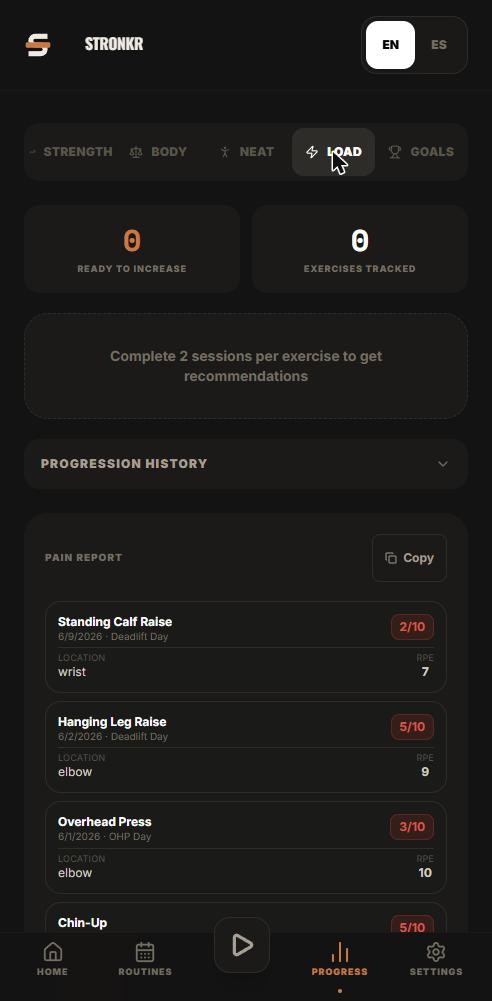
PRs You Didn't Have to Hunt For: Automatic Record Detection
Automatic pr tracking that runs off your normal sets: Stronkr detects 1RM, 5RM, volume and estimated 1RM records without you flagging a single thing.
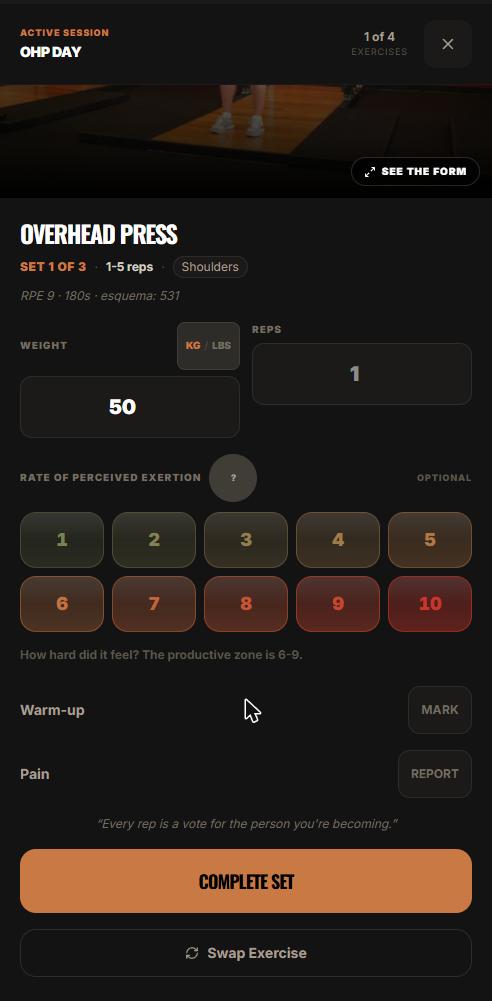
One Session End to End: From Warm-Up to Next Week's Load
A full workout logging flow, set by set: open today's session, log weight, reps and RPE, mark warm-ups, report pain, and see what changes next session.
Progressive Overload Without a Spreadsheet
A progressive overload app should do the arithmetic, not just chart it. How Stronkr turns each set's RPE into the next session's load, no sheet needed.