How to Rate Your Sets Accurately (and Get Better at It)

The Stronkr Founder Founder, Stronkr
6 min read
On this page
How to use RPE comes down to one habit and one question. The habit is rating the set immediately, before you rack the bar and start rationalising. The question is “how many more reps could I have completed with that weight”, answered in reps, not in adjectives.
Everything else is calibration, and calibration is a skill you build rather than a fact you learn. You will be wrong early. Most lifters are wrong in the same direction early. That is fine, provided you know which direction and correct for it deliberately rather than hoping the number improves on its own. What follows is how to make the rating honest, how to test it against reality, and what a systematically wrong rating does to the load you get prescribed next session.
Key takeaways
- Rate immediately after the set. Delay makes you rate your recovery rather than the set.
- Ask how many more reps you could have done, then convert: two more is an 8, one more is a 9, none is a 10.
- Expect to be wrong early and expect to be wrong low, because a lifter with no reference for failure hedges toward the middle.
- Consistently low ratings do not break the engine, they make it add load until your ratings spike and it calls a deload.
What This Looks Like in Stronkr
The rating is a control in the session, not a journal entry afterwards, and that placement is doing calibration work for you.
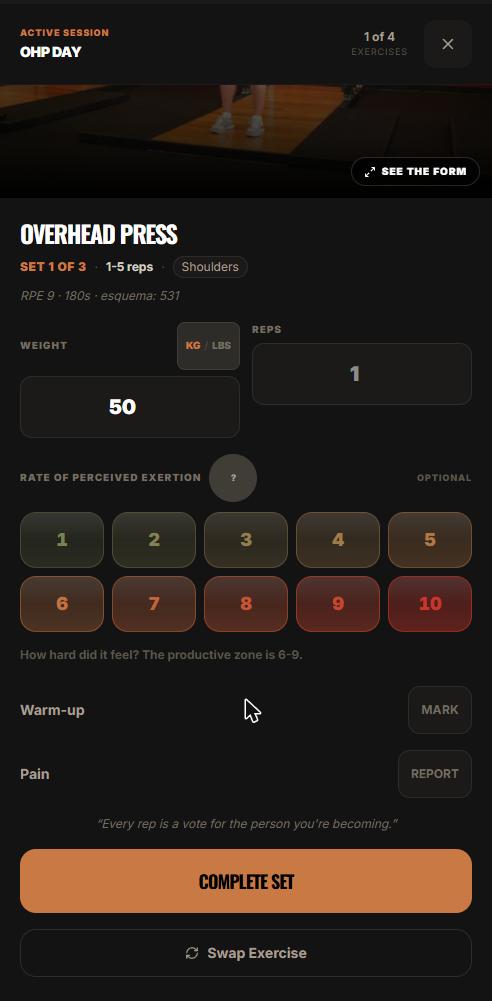
- Finish the set, Overhead Press, Set 1 of 3 on OHP DAY in this one, and enter the weight and the reps you actually completed.
- Go straight to the RPE selector below the fields. It runs 1 to 10 and is coloured green through red, so you are picking a position on a scale rather than typing a number into a void.
- Read the helper text if you need the anchor: “How hard did it feel? The productive zone is 6-9.” It is on screen for every set, which quietly stops your whole session drifting to 9s.
- Tap the
?beside the selector when you are unsure. It opens the in-app RPE explainer without ending the session. - Pick the number and tap COMPLETE SET. That value is now the input the engine uses to set your next session’s load.
The design point is the ordering: the selector sits between finishing the set and completing it, so the rating happens in the window where your estimate is still good. See how RPE auto-progression works for what the number does after that.
The best estimate you will ever make about a set is available for about ten seconds after you rack the bar.
When should you rate the set?
Immediately. Not after the rest timer, not while walking to the water fountain, not at the end of the session when you are logging everything at once.
The reason is that two different things fade at different speeds. Your memory of how close the last rep was to failing decays quickly. Your sense of general fatigue builds over the following minutes. Rate late and you are blending the two, which almost always produces a number that reflects how wrecked you feel rather than how many reps were in the tank.
Batch logging is the worst version of this. Reconstructing five sets at the end of a session produces five ratings that cluster around whatever you feel like now, which is exactly the noise the scale exists to remove.
What question should you actually ask?
“How many more reps could I have completed with that weight, with the same technique.” Answer in reps first, then convert to RPE.
Convert, do not feel
Two more available is an RPE 8. One more is a 9. None is a 10. Three more is a 7. Doing it in this order matters, because reps are countable and effort is not, that is the entire logic behind the repetitions-in-reserve scale introduced by Zourdos MC, et al. (2016) in the Journal of Strength and Conditioning Research.
Same technique counts
The reps you are counting are reps you could have done properly. A rep you could have completed by shrugging the bar up with a different movement pattern is not a rep in reserve. If your form was going to change on the next one, you were closer to your limit than the count suggests.
Do not rate the weight
An easy set with a heavy-looking number on the bar is still an easy set. The scale is about proximity to failure, not about whether the load impressed anybody, which is precisely what makes the definition of RPE 8 independent of your training age.
Why do most lifters rate too low at first?
Because they have no anchor at the top of the scale. If you have never taken a set to actual failure, you do not know what zero reps in reserve feels like from the inside, so you hedge, and hedging always moves the number toward the middle. The result is a true 9 logged as a 7.
Helms ER, et al. (2016), in the Strength and Conditioning Journal, describe applying the reps-in-reserve scale as a practical skill rather than an innate sense, and that is the right expectation. Ratings get more reliable with use.
The direction of the early error is the useful part. If you know your first month of ratings runs low, you can read your own history with that correction in mind instead of concluding the scale does not work for you.
Nobody is calibrated on day one. The mistake is not being wrong, it is being wrong in the same direction for six months without noticing.
How do you test whether your rating was right?
Occasionally check the estimate against reality. Take a set past the point where you would normally stop and count what you actually get.
Do it on something safe. A machine, a dumbbell movement, a rep-range accessory, not a heavy single, not a movement where failing means dropping a bar on yourself, and not in a session where the extra fatigue will wreck what comes after. Once every few weeks on one set is plenty.
The result is diagnostic. Called it an 8 and got two more reps: your calibration is good. Called it an 8 and got five: your scale is compressed and every rating you have logged is probably low by two points. Called it an 8 and could not get one: you were at a 10 and undercounting the top end, which is the more dangerous version because it means you are training closer to failure than your log says.
Filming a top set works as a softer version of the same test. Bar speed on the last rep tells you a lot about how many were left, and it costs you nothing in recovery.
The progression engine is on the free tier, so you can run this calibration against real prescribed loads rather than against a spreadsheet you are also maintaining.
What does a miscalibrated rating cost you?
It does not break the loop, it degrades it. Rate consistently low and the engine reads room that is not there, adds load, and keeps adding until your ratings finally spike and it calls a deload. You get there in the end, by the least comfortable route available.
Rate consistently high and the opposite happens: the engine sees a lifter permanently on the edge and holds you at loads you could have moved past. Neither failure mode is catastrophic, and both are entirely avoidable by asking the reps question honestly for a few weeks.
The other thing worth knowing is that the same information can be entered from the other end. Some lifters find it easier to think in reps left than in a 1-10 rating, and the two are the same scale, that conversion is the subject of RPE vs RIR. Where your sets should land across a session is covered in why the productive zone is 6 to 9.
An honest 7 is worth more to your programming than a flattering 9.
Start free at stronkr.com: unlimited routines, the routine generator, RPE auto-progression, ninety-day history, PR and volume tracking, offline, no credit card. Rate three sessions the way this post describes and you will have a better read on your own calibration than any article can give you.
Try auto-regulated training
Stronkr reads your RPE after every set and adjusts next session’s load for you. No spreadsheets, no guessing.
Start training with StronkrFrequently asked questions
When should I rate a set?
Immediately after racking the bar, before you sit down or check your phone. The estimate you can make in the first few seconds is the accurate one. Wait two minutes and you are rating your recovery rather than the set, which reliably drags the number downward.
What question tells me the right number?
How many more reps could I have completed with that weight, with the same technique. Answer in reps, then convert: two more is an RPE 8, one more is a 9, none is a 10. Never rate on how the set felt, because feeling has no number attached to it.
Why do newer lifters rate their sets too low?
Because they have no reference for the top of the scale. If you have never taken a set to genuine failure, you do not know what zero reps in reserve feels like, so every rating hedges toward the middle. The result is calling a true 9 a 7.
How do I check whether my ratings are honest?
Occasionally take a set past the point where you would have stopped and count the reps you actually get. If you called it an 8 and got four more, your scale is compressed. Do this on a safe movement, not a heavy single, and not every week.
Does a wrong rating break the progression engine?
Not permanently, but it makes the prescription worse. Consistently low ratings tell the engine there is room and it will keep adding load until your ratings spike and it calls a deload. The loop self-corrects, just slower and less pleasantly than accurate ratings would.
Keep reading
Autoregulation for Intermediate Lifters: A Field Guide
Autoregulation training loads the lifter you are today, not the one the spreadsheet predicted. How RPE handles bad sleep, stress and travel weeks.
Evidence-Based, Not AI-Improvised: Where Stronkr's Programming Comes From
An evidence-based workout app should tell you where its logic comes from. Stronkr's progression follows published autoregulation practice, not a chatbot.
RPE vs Percentage-Based Training on a Bad Day
RPE vs percentage training comes down to what happens when you show up under-slept. One method adapts to the day, the other assumes a max from weeks ago.