Postpartum Return to Lifting: A Structured Bridge Back

The Stronkr Founder Founder, Stronkr
6 min read
On this page
Returning to the bar after a baby is a programming problem wrapped around a medical one, and only one of those belongs in an app. The medical half is short and non-negotiable: get clearance from a qualified clinician who knows your delivery and your recovery before you load anything. What is left after that is postpartum strength training as a scheduling and load problem. How many days can you actually hold. How much recovery sits between them. What weight goes on the bar on a Tuesday when your last useful log is a year old.
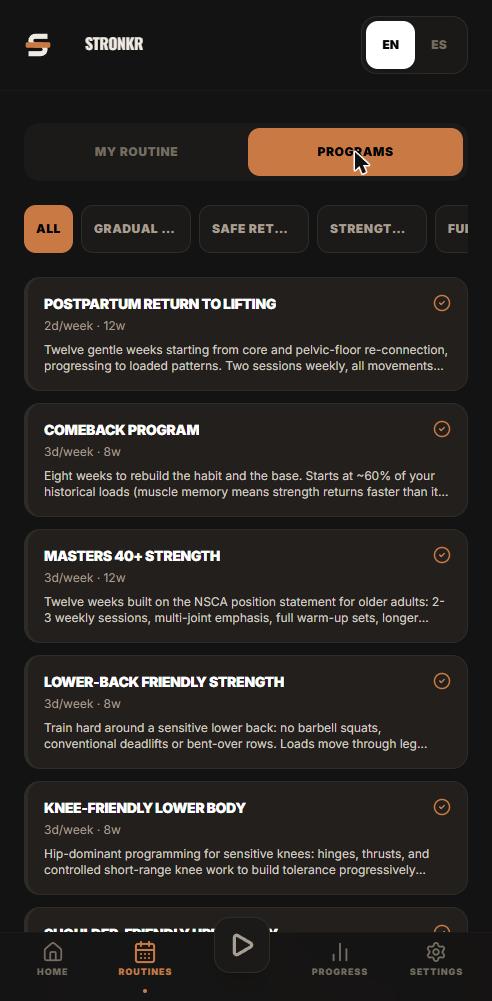
Postpartum Return to Lifting is one of six adaptive programs Stronkr ships as first-class programs. It runs two to three days a week with structured recovery built in, and it sets each next session’s load from the RPE you log rather than from numbers you no longer have.
Key takeaways
- Clearance from a qualified clinician comes first. The app handles programming after that, not instead of it.
- Postpartum Return to Lifting is a shipped program running two to three days a week with structured recovery built in.
- Starting load is found from your logged RPE over the first few sessions, not estimated from your old maxes.
- Your available equipment and the schedule you can genuinely hold are inputs to the routine, not things you work around afterward.
What This Looks Like in Stronkr
The program is something you select, and the load question resolves itself over the first couple of weeks.
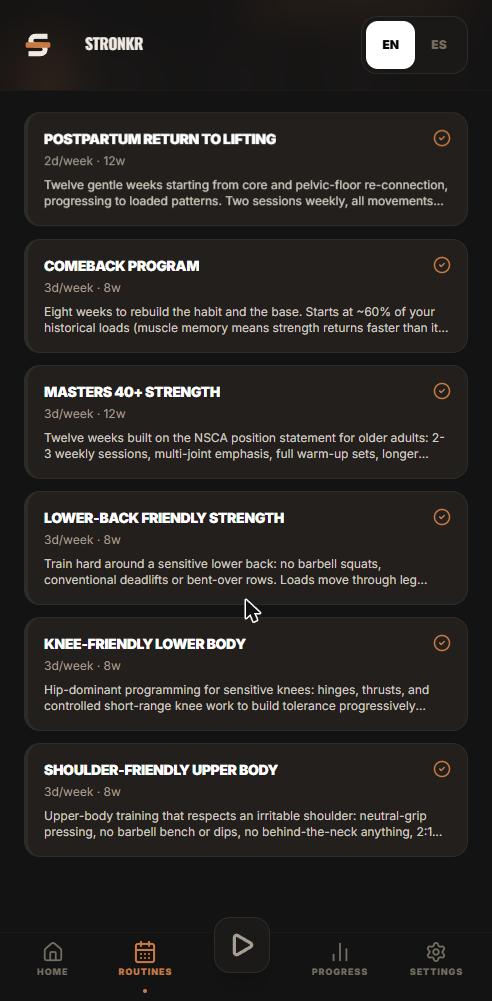
- Open the adaptive programs list. Postpartum Return to Lifting sits there with Masters 40+ Strength, the Comeback Program, Lower-Back Friendly, Knee-Friendly Lower Body and Shoulder-Friendly Upper Body.
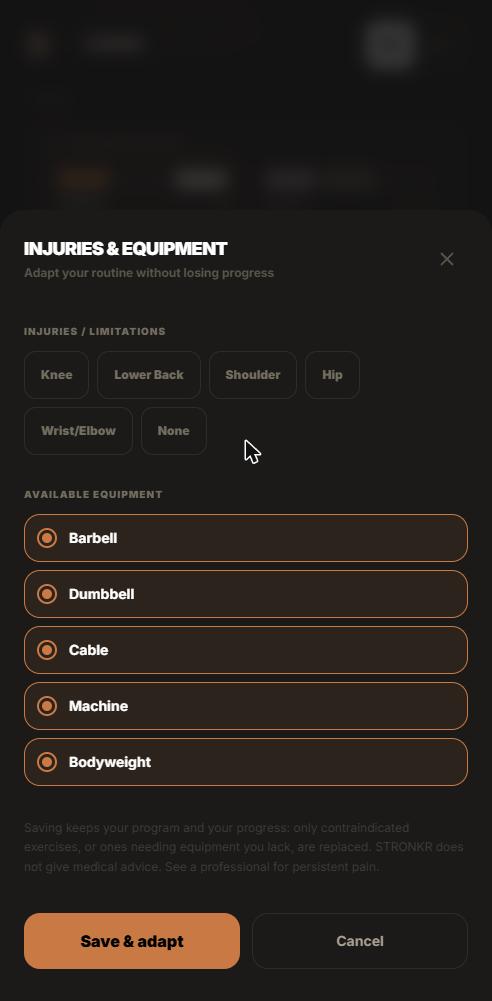
- Onboarding takes about two minutes and asks for your equipment, your schedule, your experience level and any injury areas. The routine is built from those answers.
- In-session, the set screen shows weight and reps with a KG/LBS toggle, a Warm-up MARK control, a Pain REPORT control, and the RPE 1-10 selector running green to red.
- Under the selector the helper text reads: “How hard did it feel? The productive zone is 6-9.” There is a
?next to it if you want the full explainer. - You rate each set after completing it. That rating sets the load for your next session, surfaced as a target increase such as
+5 lb, or asDeload -10%.
Why is the old template the wrong starting point?
It assumes a schedule you no longer have
A four or five day split is a commitment to a calendar. If the calendar is now built around a person who does not negotiate, the template does not fail dramatically. It fails by attrition: two sessions missed, then the block abandoned, then six weeks of nothing.
It assumes numbers you no longer have
Your old working weights were true for a body and a training history that were continuous. They are not a starting point now, they are a distraction, and chasing them is how people manufacture a bad first month back.
The old program is not too hard. It is answering questions about a life you are not currently living.
It leaves the programming job with you
Which is the part nobody has capacity for at this point. Rebuilding a template by hand, at 6am, on four hours of sleep, is exactly the work a shipped program is supposed to remove. That is the argument behind all six adaptive programs.
If you have been staring at an old spreadsheet trying to decide where to restart, onboarding is about two minutes and the program list is one screen in.
How do you pick a starting load without guessing?
You do not pick it, you find it
Start conservatively and rate honestly. You rate each set 1-10 on RPE after completing it, and that rating sets the next session’s load. Within a few sessions the targets are being driven by what your body actually did rather than by an estimate you made on day one.
Honest ratings are the whole input
The system is only as good as the number you give it. Rating a set a 7 because you wanted it to be a 7 produces targets built on fiction. How to rate sets accurately is worth ten minutes before you start, because it is the one skill the whole engine depends on.
The engine reacts to bad weeks without being told
Sleep is not a variable you can control right now. When everything feels heavier, your ratings rise and the next targets fall, and an RPE spike is what prompts a deload suggestion before you stall. RPE auto-progression explains how the rating becomes a number.
Autoregulation is not a gentler way to train. It is the only method that keeps working when your recovery is genuinely unpredictable.
Why two or three days a week?
Because it is the frequency you can hold
Postpartum Return to Lifting runs two to three days a week with structured recovery built in. That is not a reduced version of a real program. It is a program whose frequency was chosen rather than survived.
Because recovery has to be in the plan, not around it
The same reasoning sits under Masters 40+ Strength: when recovery capacity is the binding constraint, it belongs in the structure of the program instead of being something you promise yourself you will get more of.
Because completed sessions are the only ones that count
Three sessions you finish beat five you plan. The programs that fail intermediates are almost never too easy; they are too optimistic about the calendar.
How do you tell it is working when the numbers are small?
Read the line, not the absolute weight
Progress, Load shows per-exercise progression history along with a ready-to-increase recommendation. That is the screen that matters here, because the useful information is the slope of the line, not how today’s weight compares to what you were lifting eighteen months ago.
PRs get detected without you tracking them
Stronkr detects PRs automatically across 1RM, 5RM, volume and estimated 1RM. While you are rebuilding, those land more often than they do in a mature block, and you did not have to maintain a second system to notice them.
Volume tells the truth about the week
Volume tracking is the honest record of whether a week actually happened, as opposed to how it felt. The free tier keeps 90 days of history, which is enough to watch a return take shape instead of judging it by the last session you remember.
The first weeks back are not about the number on the bar. They are about whether the line moves in the right direction at a frequency you can actually sustain.
Can a training app tell me whether I am ready?
No, and it does not try to
Stronkr does not diagnose anything, does not assess your recovery, and is not a rehabilitation or clinical tool. The adaptive programs are programming accommodations: they decide frequency, structure and load. Everything on the medical side stays with the clinician who cleared you.
Stronkr installs from the browser at stronkr.com, no app store, works offline, and the core is free forever with no credit card: unlimited routines, the routine generator, RPE auto-progression, volume and PR tracking, and 90 days of history. Once you have clearance, take the program and let the first two weeks of ratings find your working loads.
Try auto-regulated training
Stronkr reads your RPE after every set and adjusts next session’s load for you. No spreadsheets, no guessing.
Start training with StronkrFrequently asked questions
When should I start lifting again after having a baby?
That is a question for the clinician who knows your delivery and your recovery, not for a training app. Stronkr does not assess readiness and does not decide when you are cleared. Once you have that clearance, Postpartum Return to Lifting handles the programming side: frequency, recovery structure and load.
What does Postpartum Return to Lifting actually give me?
A structured program rather than a template you are told to thin out yourself. It runs two to three days a week with structured recovery built in, and it is one of six adaptive programs Stronkr ships as first-class programs. The load for each next session comes from the RPE you log.
How do I know what weight to start with?
You do not have to estimate it in advance. You rate each set 1-10 for how hard it felt, and that rating sets the load for your next session. Start conservatively, rate honestly, and let a few sessions of real data find the working load instead of guessing from old numbers.
Can I use my own equipment and schedule instead of a gym?
Yes. Onboarding asks what equipment you have and what schedule you can actually hold, then builds the routine from those answers. If training moved from a commercial gym to a rack in the garage and forty minutes while the baby sleeps, that is an input rather than a compromise you patch by hand.
What if two or three sessions a week is all I can manage anyway?
Then the program already matches your life. Postpartum Return to Lifting runs at that frequency by design, with recovery structured into it, so you are not carrying a four-day template you keep failing to finish. The sessions you actually complete are the ones that produce progress.
Keep reading
Coming Back After a Layoff Without Redlining Week One
A return to lifting after a break fails in week one, not week six. How RPE-based load selection sets comeback loads from what today actually felt like.
Knee-Friendly Lower Body Training That Still Progresses
A knee friendly leg workout you select, not improvise. Stronkr substitutes only what is contraindicated and keeps the rest of your lower body progressing.
Lower-Back Friendly Lifting: Programming Around It, Not Quitting
A lower back friendly workout built for continuity. Stronkr swaps only what is contraindicated, keeps the rest progressing, and sets load from your RPE.