Knee-Friendly Lower Body Training That Still Progresses
The Stronkr Founder Founder, Stronkr
6 min read
On this page
The usual pattern with a bad knee is not that people stop training. It is that leg day slowly becomes optional. One session you skip the heavy work because the knee felt off, the next you do half the sets, and eight weeks later you have an upper body program with a hamstring curl attached. A knee friendly leg workout is supposed to prevent exactly that, and it only works if it is a real program you follow rather than a set of modifications you re-invent in the gym each week.
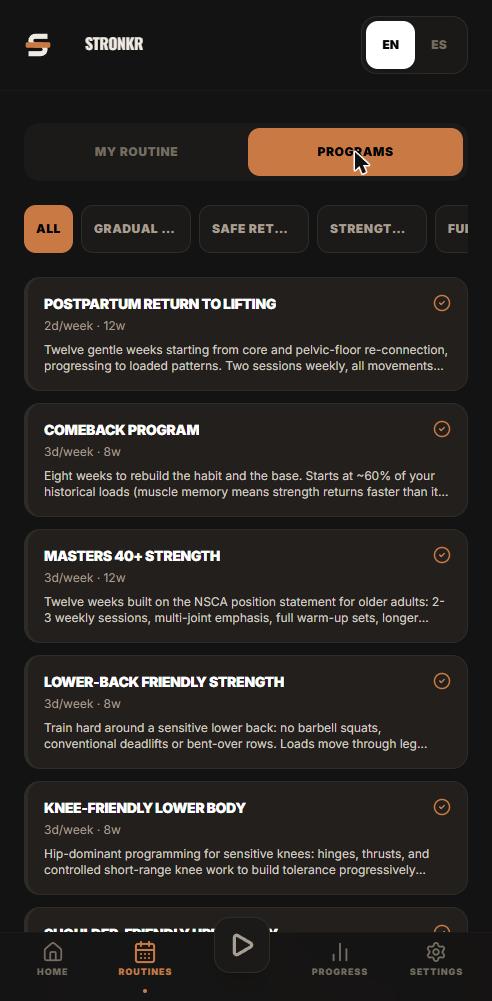
Knee-Friendly Lower Body is one of six adaptive programs Stronkr ships as first-class programs. You select it. The app substitutes only what is contraindicated for the area you flagged and keeps the rest of the program, and its progression, intact. One caveat, said once: if the knee is acutely painful, swollen or newly injured, that goes to a qualified clinician before it goes into a training app.
Key takeaways
- Knee-Friendly Lower Body is a shipped program, not a modification you improvise session by session.
- Substitution is narrow by design: only what is contraindicated changes, and the rest of the program keeps its progression.
- Anything you swap yourself is permanent, so the accommodation does not have to be re-decided weekly.
- Programming accommodation is not treatment. Acute or undiagnosed knee pain is a clinician’s problem first.
What This Looks Like in Stronkr
The knee is an input to the routine, not a patch you apply afterward.
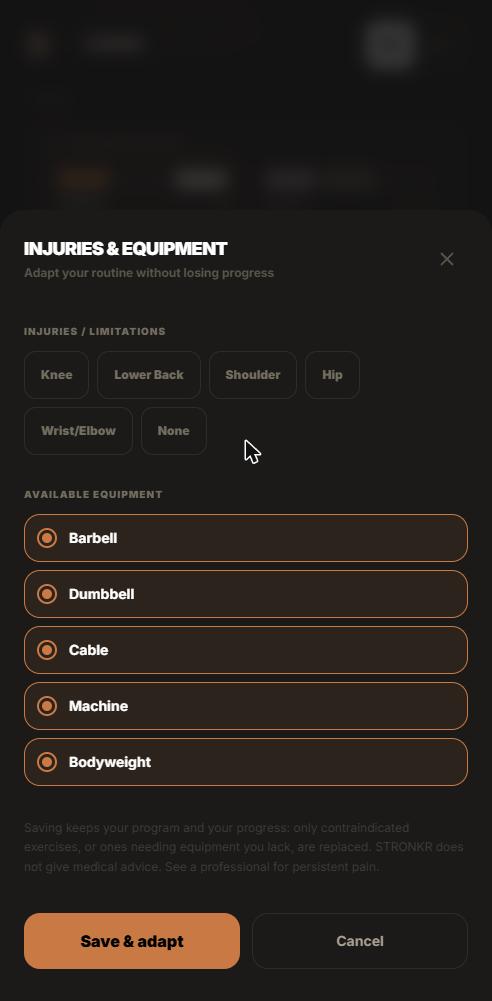
- During onboarding you mark your injury areas and the equipment you have available, alongside your schedule and experience level. It takes about two minutes.
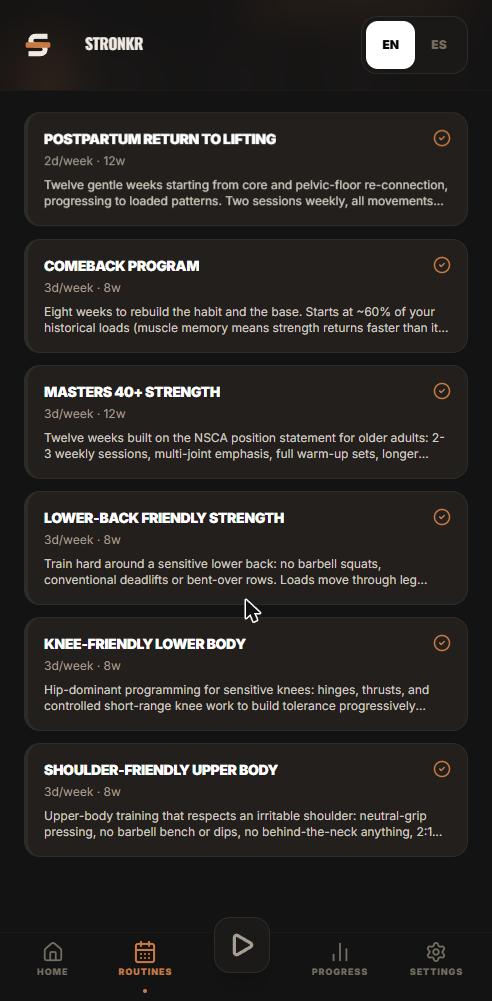
- In the adaptive programs list, Knee-Friendly Lower Body sits with Shoulder-Friendly Upper Body, Lower-Back Friendly, Masters 40+ Strength, Postpartum Return to Lifting and the Comeback Program.
- The routine you get is built from those answers, so contraindicated movements are already substituted before you see your first session.
- In-session, the set screen carries weight and reps with a KG/LBS toggle, the RPE 1-10 selector with a
?for the explainer, a Warm-up MARK control and a Pain REPORT control. - Below the COMPLETE SET button there is Swap Exercise, for anything that got through the filter and still does not agree with the joint. That swap holds for every future session.
Why does an improvised knee workaround fail?
It is a decision you have to make every single week
Improvising costs you a judgement call in the gym, under time pressure, on a joint whose behaviour changes. You will decide differently on a good week than a bad one, and the log ends up as a scatter of one-week experiments with no progression to read.
The accommodation spreads
Nobody plans to turn one substitution into a lighter leg day. It happens because once the structure is yours to maintain, the path of least resistance is doing less. A shipped program does not drift, because you are not the one holding it up.
The problem with training around a knee by feel is not that you make bad calls. It is that you make forty of them, and only some of them are bad.
The progression record breaks
Progression history in Stronkr is per exercise, and it only tells you something if the exercise stays put. A substitution that holds gives you a continuous line to read. One that resets every week gives you noise.
If leg day has been quietly shrinking for a couple of months, onboarding asks about the knee directly and the program list is one screen away.
What does the app actually change, and what does it leave alone?
Only what is contraindicated
The rule is narrow on purpose: substitute what is contraindicated or unavailable, keep the rest of the program and its progression intact. Which exact movements that touches depends on what you flagged, not on a blanket policy that removes squatting from everyone with a knee complaint.
Everything else keeps moving
Your pressing, your pulling and the lower body work the knee tolerates stay on the same RPE-driven schedule they were on before. This is the same principle behind training around a cranky shoulder and the rest of the six adaptive programs: the constraint should cost you exercises, not blocks.
You still get the final say
If a movement the program keeps does not agree with your knee, the swap sheet lists same-muscle alternatives tagged by equipment and you choose. The change is permanent, which swap it once and it remembers goes through in detail.
What if the gym changes as well as the knee?
Equipment is captured on the same screen
The onboarding step that takes your injury areas also takes the equipment you actually have. A knee constraint in a fully equipped commercial gym and the same knee constraint in a garage with a rack and two plates are different programming problems, and both are answered from that one screen.
The swap sheet is tagged for exactly this
Every alternative in the sheet carries a tag for the equipment it requires. That is what makes it usable in a hotel basement at 7am. You are reading tags against what is physically in front of you rather than mentally auditing a list of exercise names.
Constraints move, so the program has to move
Most intermediates train in more than one place across a month. A program that assumed one gym and one healthy knee will be wrong about something inside three weeks, and the hand-patched version of it will be wrong about more.
The constraint set is not fixed. Any accommodation you have to maintain manually is one busy week away from being abandoned.
How do you progress when the joint sets the ceiling?
Rate the set, get the next session’s load
You rate every set 1-10 on RPE after completing it, and that rating sets the load for your next session. The engine surfaces a target increase, such as +5 lb, or Deload -10%. That is the whole loop, and it works the same whether you are squatting or doing whatever the program gave you instead.
A cranky week lowers the target by itself
When the knee is stiff and the same load feels harder, your ratings go up and the next targets come down. You are not being asked to decide, mid-warm-up, whether today is a push day. RPE auto-progression covers how that rating turns into a number.
A constrained lifter does not need less programming. They need programming that reacts faster, because their inputs move more.
Pain is not something to progress through
There is a Pain REPORT control on the set screen so you can flag a set where something hurt. Flagging is a record for you. The right answer to a movement that hurts is to stop doing that movement and swap it, and if it keeps happening, to take it to someone qualified rather than to the app.
Stronkr installs from the browser at stronkr.com, no app store, works offline, and the core is free forever with no credit card: unlimited routines, the routine generator, RPE auto-progression, volume and PR tracking, and 90 days of history. Flag the knee in onboarding, take the program, and judge it on whether leg day stops being the one you negotiate with.
Try auto-regulated training
Stronkr reads your RPE after every set and adjusts next session’s load for you. No spreadsheets, no guessing.
Start training with StronkrFrequently asked questions
Is Knee-Friendly Lower Body a shipped program or something I build myself?
It is shipped. Knee-Friendly Lower Body is one of six adaptive programs Stronkr ships as first-class programs, next to Shoulder-Friendly Upper Body, Lower-Back Friendly, Masters 40+ Strength, Postpartum Return to Lifting and the Comeback Program. You select it rather than rebuilding a leg day around your knee by hand.
Does a knee-friendly program mean no squatting at all?
It means the app substitutes what is contraindicated for the area you flagged and keeps everything else intact. Which specific movements that removes depends on your inputs rather than on a blanket rule, and anything the program keeps still progresses on the same RPE-driven schedule as the rest of your training.
Can I still make my own substitutions inside the program?
Yes. The Swap Exercise control on the session screen opens a sheet of same-muscle alternatives, each tagged by the equipment it needs, and your choice is permanent for every future session. If a movement bothers the knee, replace it rather than working through it and hoping it settles.
Is this treating my knee?
No. These are programming accommodations, not medical care. Stronkr does not diagnose anything and is not a rehabilitation tool. If the knee is acutely painful, swollen or newly injured, that belongs with a qualified clinician first, and the app handles what you train after that.
How do I keep progressing on lower body if the knee limits me?
By progressing everything the knee does tolerate. You rate each set 1-10 on RPE and that rating sets the load for your next session, so every movement the program keeps continues to move. A lower body day with constraints is not a lower body day standing still.
Keep reading
Coming Back After a Layoff Without Redlining Week One
A return to lifting after a break fails in week one, not week six. How RPE-based load selection sets comeback loads from what today actually felt like.
Lower-Back Friendly Lifting: Programming Around It, Not Quitting
A lower back friendly workout built for continuity. Stronkr swaps only what is contraindicated, keeps the rest progressing, and sets load from your RPE.
Masters 40+ Strength: Programming for Recovery, Not Ego
Strength training over 40 fails on recovery, not effort. Masters 40+ Strength runs 2-3 days a week with structured recovery and RPE-driven load targets.