Coming Back After a Layoff Without Redlining Week One

The Stronkr Founder Founder, Stronkr
6 min read
On this page
A return to lifting after a break has one predictable failure mode, and it is not laziness. It is week one. You walk in carrying the numbers you had in March, your nervous system still remembers them, your connective tissue does not, and you spend the next ten days too wrecked to train. The layoff did not cost you the month. Week one did.
Stronkr handles the comeback with two things that already ship: the Comeback Program, one of six adaptive programs in the app, and an RPE-driven progression engine that has no opinion about what you used to lift. It only reads what today actually felt like. You rate the set you just finished, and that rating sets the load for your next session. There is no old spreadsheet number waiting to be lived up to.
Key takeaways
- The classic comeback injury is not caused by the time off. It is caused by week one at pre-layoff loads.
- The Comeback Program is one of six adaptive programs shipped in Stronkr, listed in the program catalogue rather than described as a template you are told to edit yourself.
- RPE-based load selection self-corrects, because you are rating what today felt like instead of scaling a max your body no longer owns.
- Percentages of an old one-rep max are the wrong anchor after a break. The max they refer to belongs to a body that has not trained in eight weeks.
What This Looks Like in Stronkr
Here is the actual sequence, screen by screen.
- Answer the onboarding. It takes about two minutes: your equipment, your schedule, your experience level, and the injury areas you are training around. Every routine the app builds comes out of those answers.
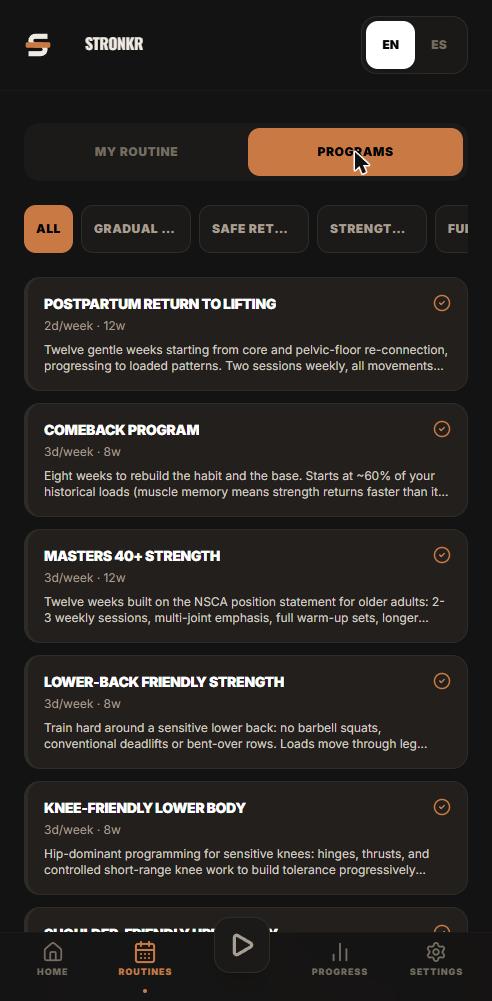
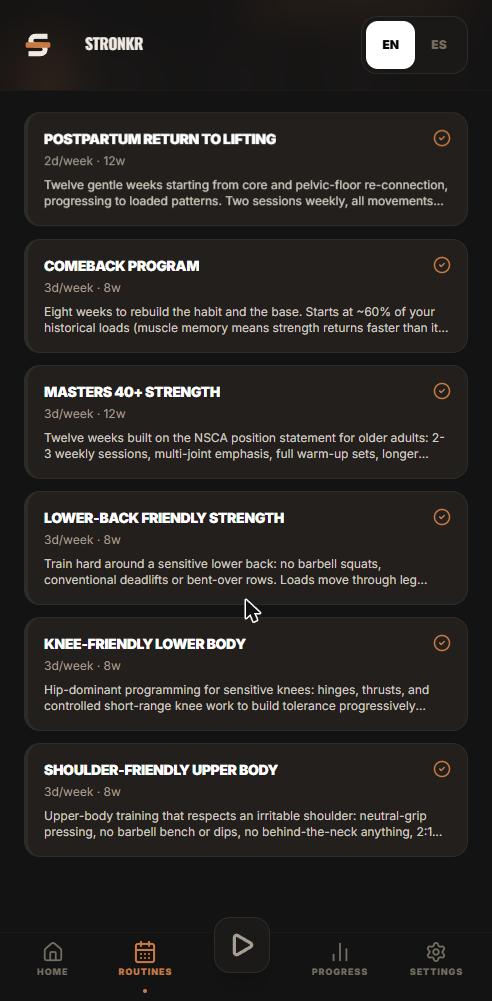
- Open the program catalogue. It lists the programs available in the app. Comeback Program sits alongside Postpartum Return to Lifting, Masters 40+ Strength, Lower-Back Friendly, Knee-Friendly Lower Body and Shoulder-Friendly Upper Body.
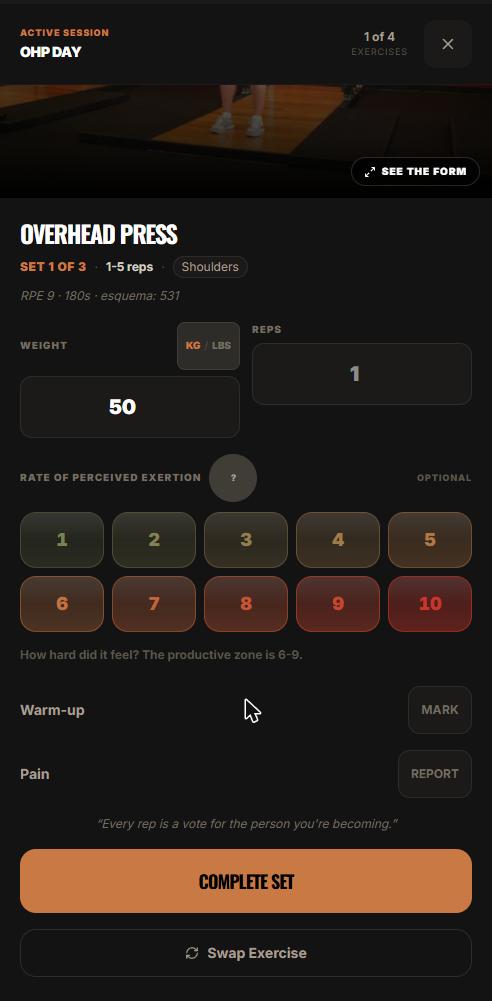
- Train the session. The set screen is headed with the day, “OHP DAY”, for example, and shows the exercise, Set 1 of 3, weight and reps fields, and a KG/LBS toggle.
- Rate the set. The RPE selector runs 1 to 10, green through red, with helper text underneath: “How hard did it feel? The productive zone is 6-9.” If the scale is new to you, the
?next to the selector opens an in-app explainer. - Use the session controls. Warm-up sets get flagged with MARK. If something goes sideways, there is a pain REPORT control. Then the orange COMPLETE SET button.
- Read what comes back. That rating is the input the engine works from. It sets the load for your next session, a target increase such as
+5 lb, orDeload -10%when your ratings say you are running hot.
Nothing in that loop asks you what you benched in March.
Why does week one after a layoff go wrong so often?
The number you remember is not a number your body agreed to
Strength is not one thing that decays at one rate. Coordination and technique hold up reasonably well over a layoff. Work capacity and connective tissue tolerance do not, and they are the ones that decide whether Thursday is trainable. The number in your head comes from the part of you that recovered fastest, which is exactly why it is a misleading place to start.
Enthusiasm is a terrible load selector
The first session back is the one session where motivation is not the problem. You are keen, you feel fine at the top of the set, and the bar moves. It moves because you can still produce force, not because you can still absorb the recovery cost. Force production comes back before recovery does, and that gap is the whole trap.
The cost gets paid in week two
Nobody quits in week one. They quit in week two, when everything hurts, the sessions get skipped, and the comeback quietly turns into another layoff. That is the failure this is written to prevent.
The layoff did not cost you the strength. Week one at March’s loads is what costs you the next month.
How does RPE decide the load when you have no idea what you can lift?
You are rating effort, not guessing a max
RPE asks a question you can actually answer after a set you have just finished: how hard did that feel. You do not have to estimate a one-rep max you have not tested since before the break. You rate the work in front of you on a 1 to 10 scale, and the engine takes it from there.
The productive zone is 6 to 9
The app tells you this on the set screen rather than making you look it up. Ratings in the 6 to 9 band are the working range. A comeback session that lands at 9 across the board is telling you something specific, and it is not “add weight”.
The trend matters more than one bad day
One rough set after eight weeks off is noise. A pattern of high ratings is signal, and it is the pattern the engine responds to when it proposes a deload rather than an increase. That is what the site means by suggesting a deload when your RPE spikes, before you stall. If you want the mechanism in detail, it is laid out in how RPE auto-progression sets your next session and in when to deload without guessing.
If you are a couple of weeks out from restarting, the cheapest move available to you is to stop rebuilding the spreadsheet and let Stronkr collect the first three sessions instead.
This is not an app-specific invention
Autoregulated loading is a studied approach, not something dreamed up for a product page. Zourdos and colleagues (2016) introduced the repetitions-in-reserve-based RPE scale used in resistance training, Helms and colleagues (2016) laid out how to apply it, and Helms and colleagues (2018) compared RPE-based loading against percentage-of-1RM loading in periodized programs matched for sets and repetitions. The reason that last one matters for a comeback is structural: percentage-based loading needs a current max, and after a break you do not have one.
Percentage-based loading needs a current one-rep max. Eight weeks off is precisely the situation in which you do not have one.
What if the gym you come back to is not the gym you left?
Equipment is an onboarding answer, not a workaround
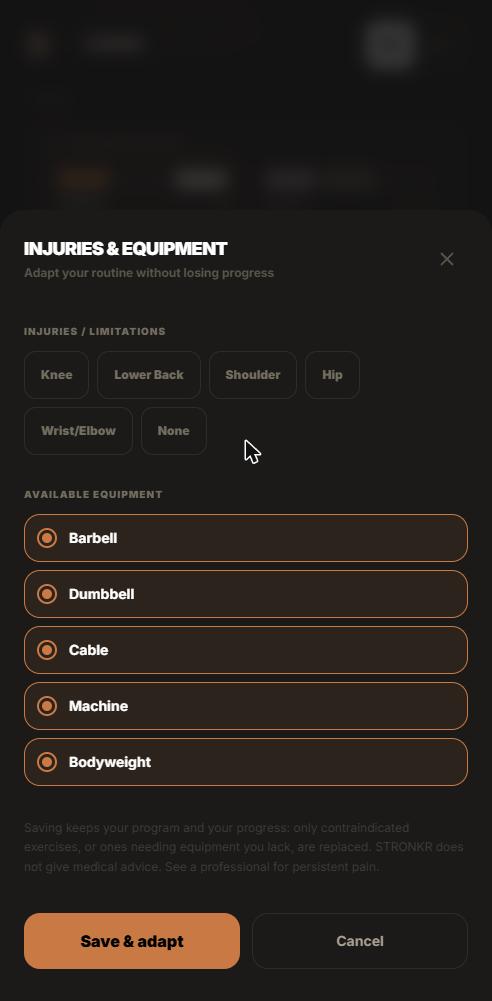
Layoffs and gym changes travel together. You moved, the membership lapsed, the rack is now a pair of dumbbells in a spare room. You answer that in onboarding, and Stronkr substitutes only what is unavailable or contraindicated, keeping the rest of the program and its progression intact.
Swap it once and it stays swapped
If you replace an exercise mid-session, the app remembers it for every future session. You are not re-making the same decision every week, which is the exact chore that makes people abandon a template and go back to improvising. The six shipped programs, including the Comeback Program, are covered in the six adaptive programs.
A comeback is a constraint problem before it is a motivation problem. Constraints are what the onboarding is for.
What does a sane comeback actually look like on the calendar?
Weeks one and two are data collection
You are not trying to hit numbers. You are trying to generate honest ratings so the engine has something to work with. Rate accurately, including the sets that felt easier than your ego wanted them to. Accurate rating is a skill, and rating your sets accurately is worth ten minutes.
Let the increase come to you
When the ratings settle into the productive zone, the target increase shows up on its own. You do not negotiate with yourself about whether to add five pounds; the next session tells you. That is the entire point of not keeping a second system.
Let the deload be automatic too
The same logic runs in the other direction. A run of high ratings gets you Deload -10% instead of a stubborn week that ends in a tweaked back. Backing off on schedule is not a setback in a comeback. It is the mechanism working.
Start free at stronkr.com, run the Comeback Program for two weeks, and rate every set honestly. No credit card, and the progression engine is on the free tier, not behind a trial that expires the week your comeback gets interesting.
Try auto-regulated training
Stronkr reads your RPE after every set and adjusts next session’s load for you. No spreadsheets, no guessing.
Start training with StronkrFrequently asked questions
How long does it take to get back to my old numbers?
Nobody can give you an honest number, and anyone who does is guessing. It depends on how long you were out, how many years you have under the bar, and what else is happening in your life. What Stronkr removes is the guessing: your rating of today's work sets the load for your next session.
Should I just start at fifty percent of my old max?
You can, but a percentage points at a one-rep max that belongs to a body which has not trained in weeks. RPE points at today. You rate the set you just finished on a 1 to 10 scale, and the engine reads that rating rather than an expired number from a spreadsheet.
Is the Comeback Program different from a generated routine?
They are two ways in. The Comeback Program is one of six adaptive programs shipped in the app and listed in the program catalogue. The routine generator is the other route: roughly two minutes of questions about your equipment, your schedule and your experience level, and it builds a routine from your answers.
What if I only have dumbbells while I rebuild?
Equipment is an onboarding answer, not a workaround. You tell Stronkr what you actually have access to, and it substitutes only what is unavailable or contraindicated while keeping the rest of the program and its progression intact. If you swap an exercise in session, that swap is permanent.
What if a set feels awful when I come back?
Rate it honestly rather than rating it optimistically. The set screen has a pain REPORT control and an RPE selector, and a rating in the red end of the scale is exactly the signal the engine needs. The site's own proof line is that it suggests a deload when your RPE spikes, before you stall.
Keep reading
Knee-Friendly Lower Body Training That Still Progresses
A knee friendly leg workout you select, not improvise. Stronkr substitutes only what is contraindicated and keeps the rest of your lower body progressing.
Lower-Back Friendly Lifting: Programming Around It, Not Quitting
A lower back friendly workout built for continuity. Stronkr swaps only what is contraindicated, keeps the rest progressing, and sets load from your RPE.
Masters 40+ Strength: Programming for Recovery, Not Ego
Strength training over 40 fails on recovery, not effort. Masters 40+ Strength runs 2-3 days a week with structured recovery and RPE-driven load targets.