Lower-Back Friendly Lifting: Programming Around It, Not Quitting

The Stronkr Founder Founder, Stronkr
6 min read
On this page
A back that flares does more damage to your training than to your back. The usual sequence is a bad rep on a Tuesday, two weeks off to be safe, a cautious return, another flare, another two weeks, and by March you have trained eleven times all year. What you want from a lower back friendly workout is not gentleness. It is continuity: a program that removes what your back does not tolerate right now and keeps everything else moving on a real progression, so there is nothing to rebuild when things settle.
Lower-Back Friendly is one of six adaptive programs Stronkr ships as first-class programs. Said once and then not repeated: if the pain is acute, new, or you do not know what is causing it, that goes to a qualified clinician before it goes into a training app.
Key takeaways
- Lower-Back Friendly is a shipped program, not a set of edits you apply to a normal template each week.
- Stronkr substitutes only what is contraindicated for the area you flagged and keeps the rest of the program and its progression intact.
- The goal is continuity of training. A full stop costs you far more than the movements you remove.
- These are programming accommodations, not treatment. Acute or unexplained back pain is a clinician’s problem first.
What This Looks Like in Stronkr
The constraint goes in at the start and the program comes out already built around it.
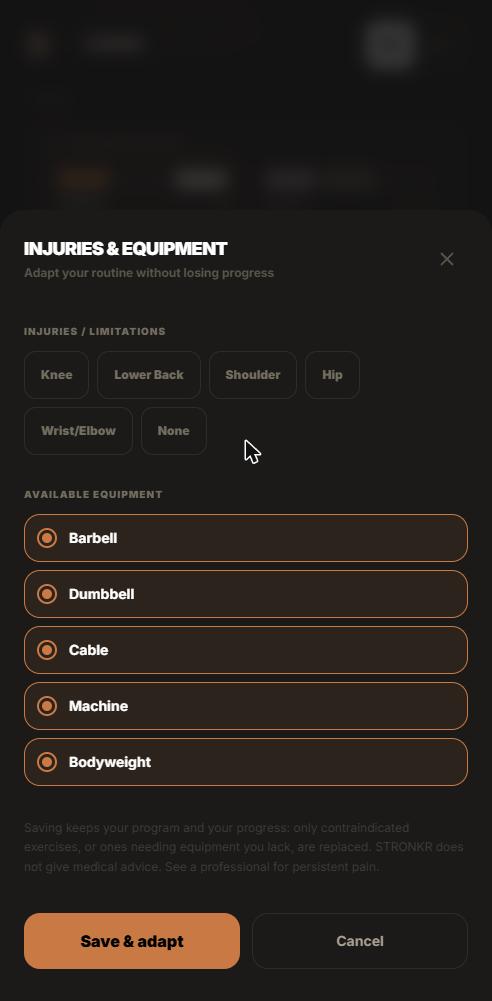
- Onboarding asks for your injury areas and available equipment, along with your schedule and experience level. It takes about two minutes.
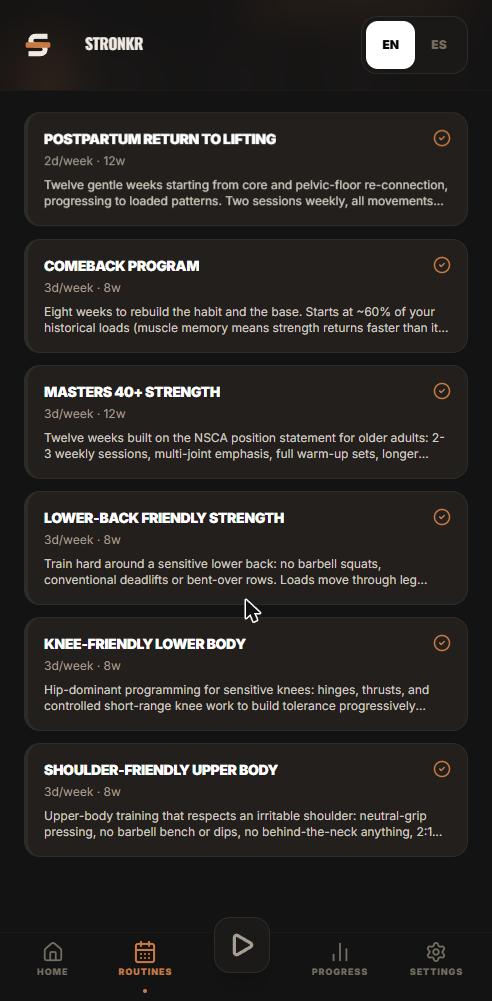
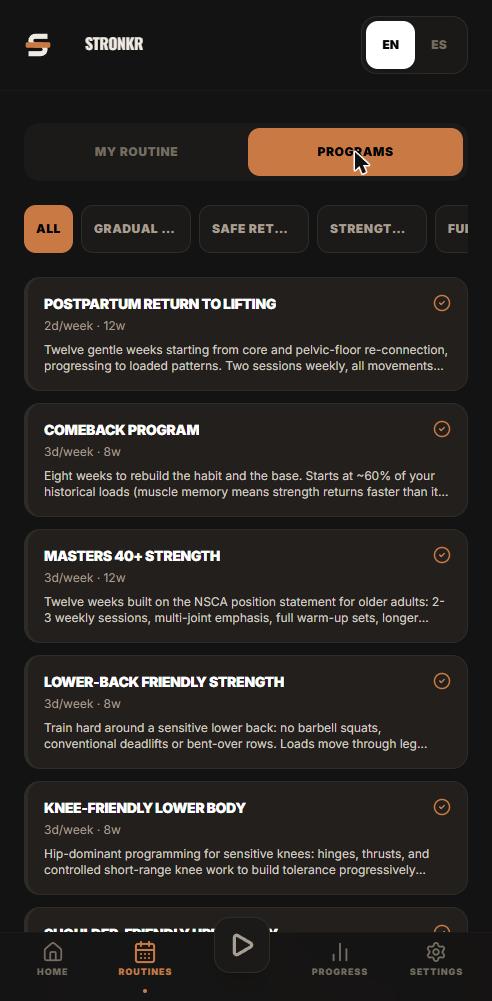
- In the adaptive programs list, Lower-Back Friendly sits with Knee-Friendly Lower Body, Shoulder-Friendly Upper Body, Masters 40+ Strength, Postpartum Return to Lifting and the Comeback Program.
- The routine that comes out has the contraindicated work already substituted. You are not handed a standard program with a note telling you to adjust it.
- In-session, the set screen shows weight and reps with a KG/LBS toggle, the RPE 1-10 selector with a
?for the explainer, a Warm-up MARK control and a Pain REPORT control. - Below the COMPLETE SET button, Swap Exercise opens a sheet of same-muscle alternatives tagged by equipment, and whatever you pick holds for every future session.
Why is stopping the most expensive option?
The cost is never two weeks
Two weeks off is never two weeks. It is two weeks off, then a cautious re-entry at reduced loads, then the weeks it takes to get back to where you were. Call it six, and then it happens again in the spring.
Detraining is a real cost with no upside
Nothing about a back that dislikes heavy hinging requires your pressing, your pulling or your single-leg work to stop. Those simply get dropped because the accommodation was manual, and the manual version of “train around it” is usually just “train less”.
Most people do not stop training because of an injury. They stop because the plan had no version of itself that survived one.
Continuity is what makes the return short
If you have kept training everything that was fine, there is no return to manage. There is a movement to reintroduce. That is a completely different problem, and a much smaller one.
If your back has been quietly deleting sessions from your week, onboarding asks about it directly and the program list is one screen away.
What does a lower-back friendly program actually change?
Only what is contraindicated
The substitution rule is deliberately narrow: replace what is contraindicated or unavailable, keep the rest of the program and its progression intact. That is the same rule behind knee-friendly lower body and training around a cranky shoulder, and it is what stops an accommodation from turning into a different, smaller program.
It is a program, not a warning label
The difference between a shipped program and a modification is who maintains it. A modification decays, because on a busy week you will do the easy version of it. A program does not, because you did not build it and you are not the one holding it together. That principle is the reason all six adaptive programs exist as programs rather than settings.
You keep the final call on individual movements
If something the program kept still aggravates your back, the swap sheet lists same-muscle alternatives tagged by equipment and the change is permanent. You are not stuck arguing with a prescription.
How do you keep progressing through good and bad weeks?
RPE absorbs the variability
You rate every set 1-10 after completing it, and that rating sets the load for your next session. The engine surfaces a target increase, such as +5 lb, or Deload -10%. A stiff week raises your ratings and lowers the next targets without you making a conscious call about it.
The deload is prescribed, not guessed
Stronkr suggests a deload when your RPE spikes, before you stall. For a lifter managing a back that comes and goes, this is the decision most often made badly in both directions, and deloading without guessing covers what the engine is reading when it makes it.
A back that flares is a variable input. Fixed percentage tables cannot see it. Ratings you give after every set can.
Progress stays legible
Because only the contraindicated movements changed, the rest of your progression history stays continuous rather than fragmenting into a series of improvised weeks. You can read the line and see whether the block is working.
Is an app any use here, or is this just a log?
A tracker faithfully records that you did less
Your current app will store the eight weeks where your back was bad and your volume halved. It will not tell you what to lift instead, and it will not adjust anything when the back settles. It archives the problem and hands it back to you.
An engine prescribes the next session
Stronkr reads the RPE you logged and produces the load for your next session, which is the work you would otherwise be doing in a spreadsheet at 6am. That is the category difference, and it matters most exactly when your inputs are unstable.
It also has to work where you actually are
It is a PWA: it installs from the browser, needs no app store, and works offline. That is relevant when the back-friendly version of your week happens in a garage with bad signal rather than in the gym you normally use.
Continuity is not a motivational idea. It is the difference between reintroducing one movement and rebuilding a whole block.
Can a training app do anything about the pain itself?
No, and it does not claim to
Stronkr does not diagnose anything, does not prescribe rehabilitation, and is not a clinical tool. The adaptive programs are programming accommodations: they change what you are told to lift. There is a Pain REPORT control on the set screen so you can flag a set where something hurt, and the correct response to a movement that hurts is to stop doing it and swap it, not to push through and see.
Stronkr installs from the browser at stronkr.com, no app store, works offline, and the core is free forever with no credit card: unlimited routines, the routine generator, RPE auto-progression, volume and PR tracking, and 90 days of history. Flag the back in onboarding, take the program, and judge it on whether you are still training in six weeks.
Try auto-regulated training
Stronkr reads your RPE after every set and adjusts next session’s load for you. No spreadsheets, no guessing.
Start training with StronkrFrequently asked questions
Is Lower-Back Friendly a shipped program or a modification I make myself?
It is shipped. Lower-Back Friendly is one of six adaptive programs Stronkr ships as first-class programs, alongside Knee-Friendly Lower Body, Shoulder-Friendly Upper Body, Masters 40+ Strength, Postpartum Return to Lifting and the Comeback Program. You select it rather than deciding session by session which parts of your program to drop.
Does a lower-back friendly program mean I stop deadlifting?
It means whatever is contraindicated for the area you flagged gets substituted and the rest of the program stays intact. Which movements that affects follows from your inputs, not from a blanket rule applied to everyone who has ever tweaked a back. Whatever remains keeps progressing normally.
Why not just take time off until it settles down?
Because a full stop is hard to come back from and it is rarely the programming answer. The point of the program is continuity: keep training what you can train, on a real progression, instead of spending six weeks rebuilding. Anything acute is a clinician's call, not a training app's.
What if a movement in the program still aggravates my back?
Swap it. The Swap Exercise control on the session screen lists same-muscle alternatives tagged by equipment, and the substitution carries into every future session. Nothing in the program is worth training through pain to keep, and a swap costs you one session rather than a rebuilt routine.
How does the app know when to back off?
You rate each set 1-10 on RPE after completing it, and those ratings set the load for your next session. Stronkr suggests a deload when your RPE spikes, before you stall, so a week where everything feels heavier lowers your targets without you having to make that call yourself.
Keep reading
Coming Back After a Layoff Without Redlining Week One
A return to lifting after a break fails in week one, not week six. How RPE-based load selection sets comeback loads from what today actually felt like.
Knee-Friendly Lower Body Training That Still Progresses
A knee friendly leg workout you select, not improvise. Stronkr substitutes only what is contraindicated and keeps the rest of your lower body progressing.
Masters 40+ Strength: Programming for Recovery, Not Ego
Strength training over 40 fails on recovery, not effort. Masters 40+ Strength runs 2-3 days a week with structured recovery and RPE-driven load targets.