Six Adaptive Programs Most Training Apps Don't Ship
The Stronkr Founder Founder, Stronkr
5 min read
On this page
Most training apps handle constraints the same way: here is a four-day upper/lower split, swap out anything that hurts, good luck. That hands the programming work straight back to the person least equipped to do it at 6am. Stronkr ships six adaptive workout programs as first-class programs in the library instead, postpartum return, masters 40+, a comeback block after time off, and lower-back, knee and shoulder friendly training. They are not modifications you make. They are programs with their own frequency, length and constraints, built before you open them, running on the same RPE progression engine as everything else. Here is what each one addresses and why shipping them as programs rather than as advice changes the outcome.
Key takeaways
- Six programs ship in the library: Postpartum Return to Lifting, Masters 40+ Strength, Comeback Program, Lower-Back Friendly, Knee-Friendly Lower Body and Shoulder-Friendly Upper Body.
- They are first-class programs with real frequency, length and constraints, not templates with an instruction to edit them yourself.
- Postpartum Return to Lifting and Masters 40+ Strength run two to three days a week with structured recovery built in.
- These are programming accommodations, not medical care. Training around a constraint is not treating it.
What This Looks Like in Stronkr
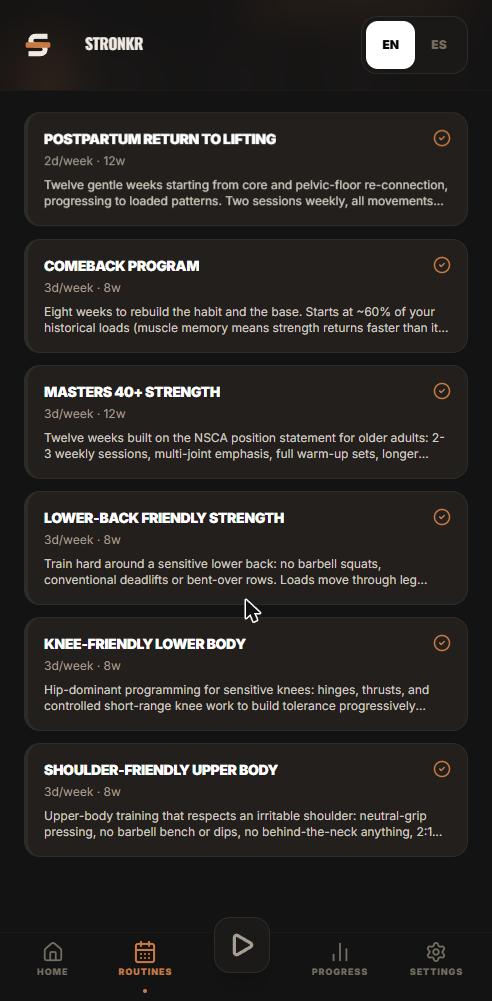
The programs live in the library beside everything else, which is the point, they are not a special-cases menu bolted on the side.
- Open the program catalogue to see the available programs listed together.
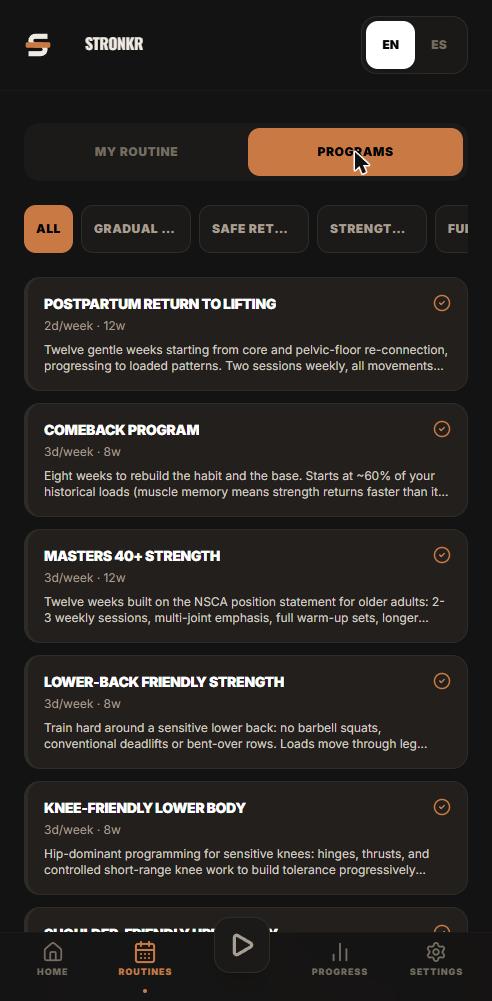
- Move to the special programs section, shown above, which holds the adaptive tracks: postpartum, masters 40+, comeback and the joint-friendly programs.
- Pick the one that matches your situation. The frequency and constraints are part of the program you selected, not settings you configure afterwards.
- Train it like any other program. Sets are logged with weight, reps and an RPE rating from 1 to 10 on the set screen, and the engine sets your next session’s load from those ratings.
Nothing about picking an adaptive program moves you into a reduced version of the app. You keep the same progression, the same PR detection and the same history.
What are the six programs, and who is each one for?
Postpartum Return to Lifting
For returning to the bar after pregnancy, on a schedule that assumes your recovery capacity is the binding constraint rather than your motivation. It runs two to three days a week with structured recovery built in, which is a programming decision made in advance rather than a suggestion to take it easy. The full postpartum walkthrough covers how the return is structured.
Masters 40+ Strength
For lifters past forty who can still train hard but cannot recover from four heavy days the way they did at 28. Also two to three days a week with structured recovery. The frequency is the accommodation, everything else is normal strength training. Masters 40+ strength training goes into what changes and what does not.
Comeback Program
For coming back after a layoff, when your technique remembers more than your tissue does. The trap after time off is training at the loads you remember instead of the ones you currently have, and a structured comeback block exists to stop that.
Lower-Back Friendly
For training around a back that objects to specific patterns. It keeps the training and works around the movements that cause a problem, rather than deleting lower-body work entirely because one exercise hurts.
Knee-Friendly Lower Body
For lifters whose knees dictate exercise selection. The premise is the same: you still train legs, with selection built around the constraint. Knee-friendly lower body training covers the practical version.
Shoulder-Friendly Upper Body
For the cranky shoulder that flares on some pressing patterns and not others. Pressing does not disappear; the program is built to keep it available. Training around a cranky shoulder is the deeper post.
A constraint does not need a lighter version of a program. It needs a program that was written with the constraint already in it.
Why does shipping them as programs matter?
A template makes the constraint your problem
When an app hands you a standard split and tells you to substitute what hurts, it has moved the hardest decision, which movements to keep, what replaces them, and how to keep the volume coherent, onto the lifter, mid-session, with a barbell waiting. That is the spreadsheet problem in a different outfit.
A shipped program has already made those decisions
Selecting Shoulder-Friendly Upper Body means the exercise selection, the structure and the constraints were resolved before you opened the app. You are choosing a program, not repairing one. The difference is not philosophical: it is the difference between training on Tuesday and re-planning on Tuesday.
It is also harder to fake
Any app can add a filter labelled “joint friendly”. Shipping six programs with real frequency, length and constraints is work that has to be done once per program and cannot be generated on demand. That is the reason most apps do not ship them.
If you want to look at the six before committing to anything, the app installs from the browser and the core is free with no credit card.
What does two to three days a week with structured recovery buy you?
Frequency as a programming variable, not a compromise
For a postpartum return or a lifter past forty, the limiting factor is usually recovery, not willingness. Building the program at two to three sessions a week means the recovery is designed in rather than improvised after a bad week. A four-day program run at two days is not the same thing, it is a four-day program you are failing.
Structured recovery beats intuitive backing-off
Deciding session by session whether to push tends to produce either chronic under-training or a stubborn week that costs three. Having the recovery written into the program removes that decision from the moment you are least able to make it well.
How do the adaptive programs interact with the rest of the app?
Constraints are also collected at onboarding
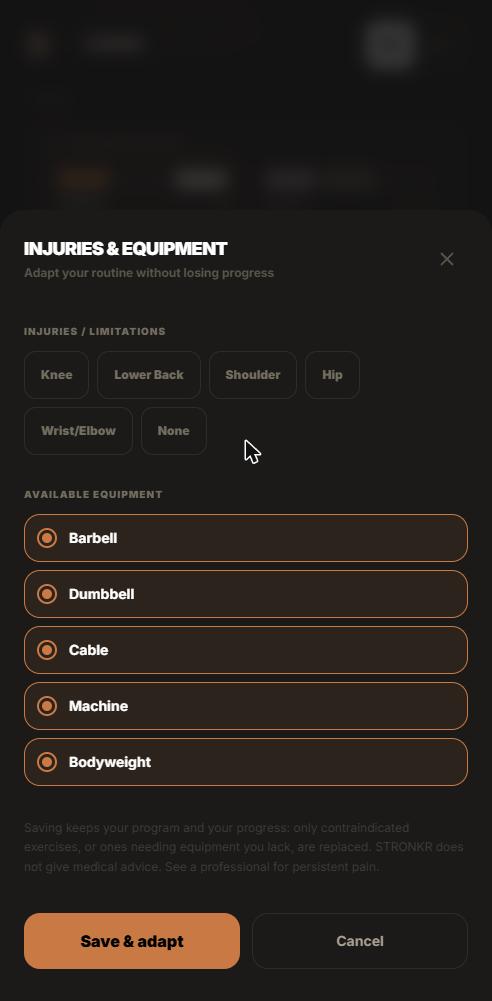
Injury areas and available equipment are things you select during onboarding, and the app substitutes only what is contraindicated or unavailable, the rest of the program and its progression stay intact. That applies whether you are on an adaptive program or a generated routine.
Swaps are permanent
If you swap an exercise, it stays swapped for every future session rather than reverting next week. You make the decision once.
Progression does not change
Every program runs the same loop: rate each set from 1 to 10, and the engine prescribes your next session’s load, a target increase such as +5 lb, or Deload -10%. The site’s framing is that it suggests a deload when your RPE spikes, before you stall. A constraint changes what you lift, not whether the numbers move.
These are programming accommodations, not medical care. Training around a joint is not treating it, and no part of this app pretends otherwise.
Install Stronkr free at stronkr.com, open the program library, and see whether the constraint you have been working around by hand is already a program someone wrote for it.
Try auto-regulated training
Stronkr reads your RPE after every set and adjusts next session’s load for you. No spreadsheets, no guessing.
Start training with StronkrFrequently asked questions
What are the six adaptive programs in Stronkr?
Postpartum Return to Lifting, Masters 40+ Strength, Comeback Program, Lower-Back Friendly, Knee-Friendly Lower Body and Shoulder-Friendly Upper Body. All six sit in the program library as first-class programs with their own frequency, length and constraints, rather than as templates you are told to modify.
Are these medical or rehabilitation programs?
No. They are programming accommodations built around a constraint, training around a cranky joint or a return to lifting, not treating anything. There is no clinical review, no diagnosis and no prescribed rehab. If something hurts in a way that needs a clinician, see one first.
How often do the postpartum and masters programs train?
Postpartum Return to Lifting and Masters 40+ Strength both run two to three days a week with structured recovery built in. That frequency is part of the program design rather than a setting you dial down yourself after picking a standard four-day split.
Do the adaptive programs still use RPE progression?
Yes. Every program runs on the same engine: you rate each set 1 to 10 after completing it, and that rating sets the load for your next session. Constraints change which exercises you do, not whether progression happens or how it works.
What if my constraint is not one of the six?
Use the routine generator instead. You give it your equipment, schedule, experience level and injury areas during a roughly two-minute onboarding, and it builds a routine around them. Routines are unlimited on the free tier, so generating another costs nothing.
Keep reading
Coming Back After a Layoff Without Redlining Week One
A return to lifting after a break fails in week one, not week six. How RPE-based load selection sets comeback loads from what today actually felt like.
Knee-Friendly Lower Body Training That Still Progresses
A knee friendly leg workout you select, not improvise. Stronkr substitutes only what is contraindicated and keeps the rest of your lower body progressing.
Lower-Back Friendly Lifting: Programming Around It, Not Quitting
A lower back friendly workout built for continuity. Stronkr swaps only what is contraindicated, keeps the rest progressing, and sets load from your RPE.