Masters 40+ Strength: Programming for Recovery, Not Ego

The Stronkr Founder Founder, Stronkr
6 min read
On this page
Strength training over 40 rarely goes wrong on the lifting. It goes wrong on the space between the lifting. You can still hit the same numbers, sometimes better numbers than at 30, but the four-day upper-lower split that worked for a decade starts producing a Thursday where everything feels like lead and a Saturday you skip. Then you blame age, or motivation, or your job, and you cut the weights instead of cutting the frequency.
The variable that changed is recovery capacity, not capability. Masters 40+ Strength is one of six adaptive programs Stronkr ships as first-class programs. It runs two to three days a week with structured recovery built in, and it prescribes load from the RPE you log rather than from a percentage table that has no idea what kind of week you have had.
Key takeaways
- Masters 40+ Strength is a shipped program, not a template you are told to thin out yourself.
- It runs two to three days a week with structured recovery built into the program.
- Load comes from your logged RPE, so a heavy-feeling week produces lower targets without you deciding that consciously.
- The change is frequency and recovery placement. Nobody is asking you to lift less than you can.
What This Looks Like in Stronkr
The adaptive programs are a list you pick from, not a settings screen you configure.
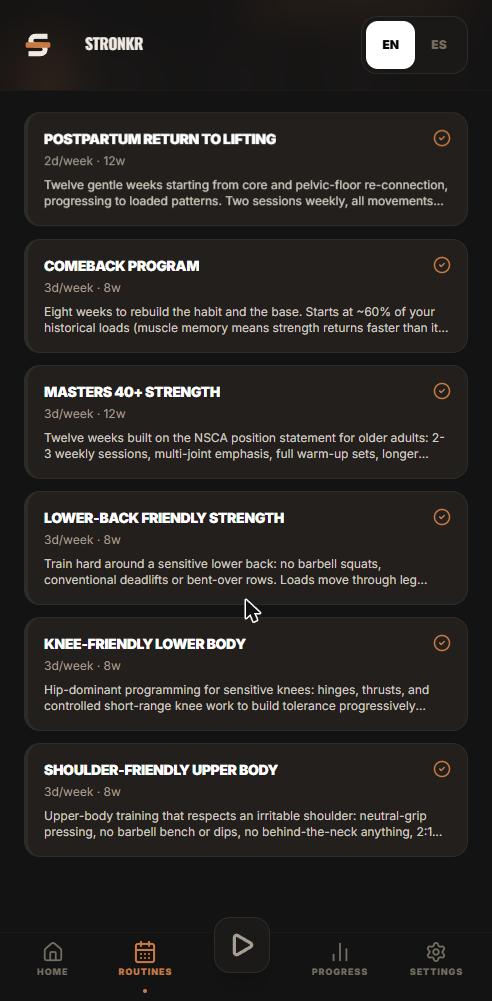
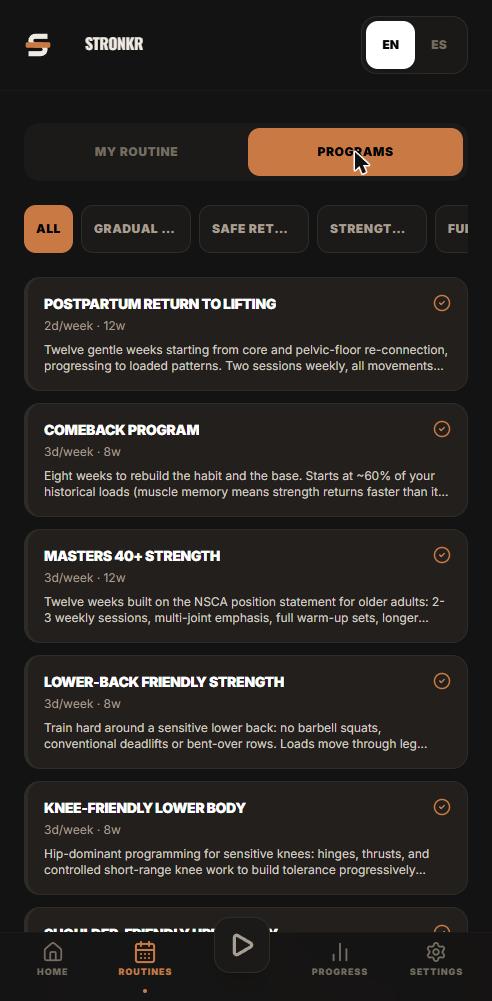
- Open the adaptive programs view. Masters 40+ Strength sits there alongside Postpartum Return to Lifting, the Comeback Program, Lower-Back Friendly, Knee-Friendly Lower Body and Shoulder-Friendly Upper Body.
- Pick it. The frequency and the recovery structure are part of the program, so there is no weekly-volume slider for you to get wrong.
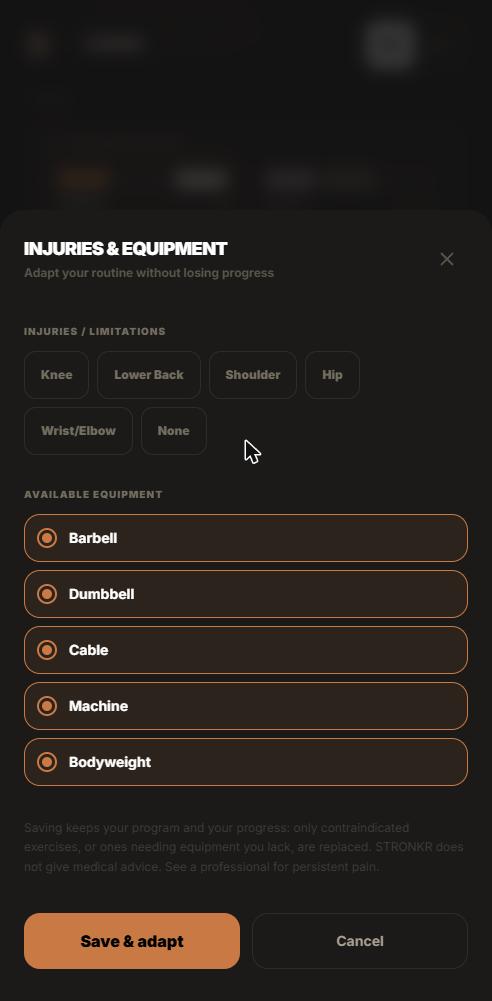
- Onboarding still asks for your equipment, your injury areas and your experience level, so the program you get is built for your rack and your joints, not a generic one.
- In-session, you log weight and reps with the KG/LBS toggle and rate the set 1-10 on RPE. There is a
?next to the selector with the explainer if you want it. - That rating sets the load for your next session. The engine surfaces either a target increase, such as
+5 lb, orDeload -10%.
Why does frequency matter more than load after 40?
The session was never the problem
A hard squat session at 42 is not meaningfully different from a hard squat session at 32. What differs is how much of the next 72 hours it consumes. Programs fail when the next session arrives before the previous one has been absorbed, and then the failure looks like weakness rather than scheduling.
Two or three quality sessions beat four compromised ones
A four-day week where two of the days are junk is not four days of training. It is two days of training plus two days of accumulated fatigue with no stimulus attached. Cutting to two or three deliberate sessions with recovery structured around them is not a concession.
Nobody over 40 gets weaker from training three days a week. Plenty get weaker from insisting on five.
Recovery has to be structural, not aspirational
Telling yourself to sleep more and take the odd deload week is aspiration. Building the frequency and the recovery into the program is structure. That is why Masters 40+ Strength is a separate program in the six adaptive programs rather than a checkbox on a standard split.
If you have been quietly running a four-day template you no longer recover from, onboarding takes about two minutes and the program list is right there.
How does RPE handle a body whose readiness moves week to week?
You rate the set, the app sets the load
After each set you rate it 1-10 for how hard it felt. That rating feeds the algorithm that sets your load for the next session. There is no separate readiness questionnaire and no wearable to sync. The rating you already have in your head becomes the input.
A heavy week produces smaller targets automatically
The week after a bad flight, a sick kid or four hours of sleep, the same weight feels harder and you rate it higher. The next session’s target reflects that. You do not have to make a judgement call at 6am about whether to push, which is exactly the call people over 40 get wrong in both directions.
Deloads stop being superstition
Stronkr suggests a deload when your RPE spikes, before you stall. That is a mechanism, not a hunch about how the block is going. Deloading without guessing covers what the engine reads when it makes that call, and the productive zone is 6 to 9 covers what your ratings should mostly look like when a block is running properly.
Percentage tables assume every Tuesday is the same Tuesday. After 40 that assumption stops being harmless.
What if I am over 40 and also training around a joint?
That is the normal case, not an edge case
Most lifters who want a masters program also have a shoulder, a knee or a back with a history. Onboarding asks for your injury areas and your available equipment regardless of which program you take, so the constraint goes in at the same time as everything else rather than being bolted on later.
Substitution stays narrow
The rule does not change: replace what is contraindicated or unavailable and keep the rest of the program, and its progression, intact. A bad shoulder should cost you some pressing variations. It should not cost you the two or three sessions a week you were going to do anyway.
In-session overrides are permanent
If something the program kept still bothers the joint, Swap Exercise sits below the COMPLETE SET button and the alternative you pick applies to every future session. You make the accommodation once instead of relitigating it every week, which is the thing that quietly ends most training blocks after 40.
Recovery capacity and a cranky joint are separate constraints. The mistake is reading either one as a reason to train less rather than a reason to train differently.
Is autoregulation actually established practice?
The scale comes from published work
The repetitions-in-reserve form of the RPE scale used here comes from the strength-training literature: Zourdos MC, et al. (2016), Novel resistance training-specific rating of perceived exertion scale measuring repetitions in reserve, and Helms ER, et al. (2016), Application of the repetitions in reserve-based rating of perceived exertion scale for resistance training.
RPE loading has been compared to percentage loading directly
Helms ER, et al. (2018), RPE vs. percentage 1RM loading in periodized programs matched for sets and repetitions, compared the two loading approaches head to head. The point of citing it here is narrow: autoregulating load by RPE is an established method in the literature, not something invented for an app.
This is methodology, not a chatbot
The engine follows autoregulation practice from that literature. It is not a language model improvising a workout, and the six adaptive programs are structured programs with real frequency and constraints rather than a starting point you are told to edit. If you want the mechanism in full, RPE auto-progression walks through how a rating becomes a number.
Stronkr installs from the browser at stronkr.com, no app store, works offline, and the core is free forever with no credit card: unlimited routines, the routine generator, RPE auto-progression, volume and PR tracking, and 90 days of history. Pick Masters 40+ Strength, log a week, and judge it on whether Thursday stops feeling like lead.
Try auto-regulated training
Stronkr reads your RPE after every set and adjusts next session’s load for you. No spreadsheets, no guessing.
Start training with StronkrFrequently asked questions
What actually changes in a program written for lifters over 40?
Frequency and recovery structure, mostly. Masters 40+ Strength runs two to three days a week with structured recovery built in, rather than the four-to-six-day layout most templates assume. The lifts and the progression logic are the same as anywhere else. What changes is how much work sits between them.
Does training over 40 mean training lighter?
Not inherently. Recovery capacity is the variable that changes, not capability. Loads in Stronkr come from the RPE you rate after each set, so if you are handling heavy work well you keep being given heavy work. The program adjusts the schedule around the load, not the ambition.
Why is Masters 40+ a separate program instead of a setting?
Because frequency and recovery placement are structural, not a toggle you bolt onto a four-day upper-lower split. Stronkr ships six adaptive programs as first-class programs, and Masters 40+ Strength is one of them, with its own weekly frequency and its own recovery structure already decided.
Is the RPE approach based on published research?
The repetitions-in-reserve version of the RPE scale comes from published strength-training work, including Zourdos and colleagues in 2016 and Helms and colleagues in 2016. Helms and colleagues also compared RPE-based against percentage-based loading in periodized programs matched for sets and repetitions in 2018.
Can I still run my own split instead of a shipped program?
Yes. The routine generator builds from your equipment, schedule, experience level and injury areas, and the free tier includes unlimited routines. Masters 40+ Strength is there for when you would rather have frequency and recovery decided structurally than renegotiate them with yourself every week.
Keep reading
Coming Back After a Layoff Without Redlining Week One
A return to lifting after a break fails in week one, not week six. How RPE-based load selection sets comeback loads from what today actually felt like.
Knee-Friendly Lower Body Training That Still Progresses
A knee friendly leg workout you select, not improvise. Stronkr substitutes only what is contraindicated and keeps the rest of your lower body progressing.
Lower-Back Friendly Lifting: Programming Around It, Not Quitting
A lower back friendly workout built for continuity. Stronkr swaps only what is contraindicated, keeps the rest progressing, and sets load from your RPE.