Why the Productive Zone Is RPE 6-9

The Stronkr Founder Founder, Stronkr
7 min read
On this page
Finish a set in Stronkr and the app asks one question: how hard did it feel. Under the 1-10 selector sits a line that carries more weight than its size suggests, the productive zone is 6-9. That RPE productive zone is not a comfort band or a motivational range. It is the span where a set is hard enough to be worth doing and cheap enough that you can repeat it on Thursday, and it is the range the progression engine reads when it decides what goes on the bar next session. Below 6 you are mostly moving warm-up weight. At 10 you are borrowing recovery from the rest of the week and paying it back with interest. Here is what each end of that range costs and returns.
Key takeaways
- On the reps-in-reserve scale, RPE 6 is roughly four reps left, 8 is roughly two, 10 is none. The productive zone is the band where effort is real and still repeatable.
- Sets below 6 are not wasted. They are warm-ups, technique work and easy volume. They just do not drive much for someone three years into training.
- Living at 10 does not fail on the day. It fails two sessions later, when the load you can repeat has quietly dropped.
- Stronkr reads the rating you give each set and uses it to set the next session’s load, a target increase, or a deload when your RPE spikes.
What This Looks Like in Stronkr
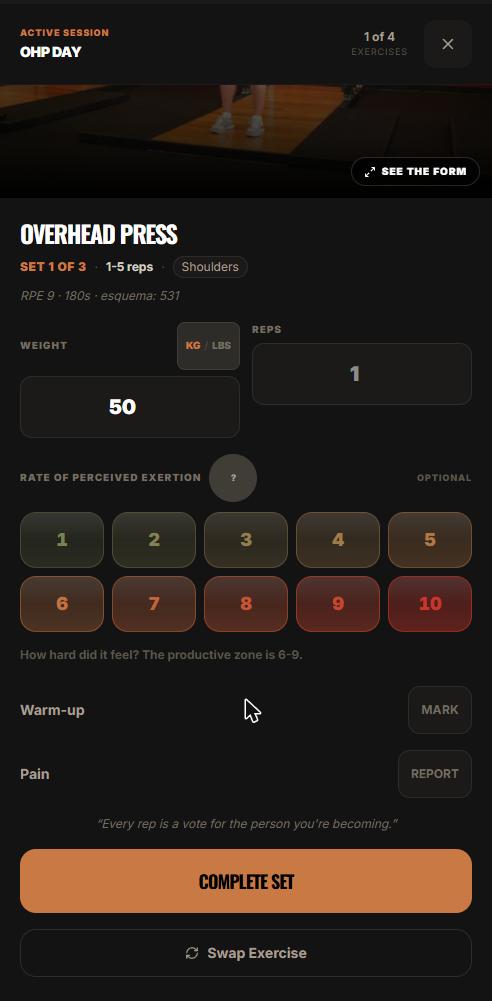
The rating happens on the set screen, not in a settings menu. In the screenshot above the session is OHP DAY, the exercise is Overhead Press, and the screen is on Set 1 of 3.
- Enter what you actually did in the weight and reps fields. The KG-LBS toggle sits with them if you train in the other unit.
- Rate the set on the RPE selector, which runs 1 to 10 and shades from green to red as the numbers climb.
- Read the helper text directly under the selector: “How hard did it feel? The productive zone is 6-9.”
- If the scale is unfamiliar, tap the question mark next to the selector to open the in-app RPE explainer.
- Use MARK to flag the set as a warm-up, or REPORT to log pain, if either applies to what just happened.
- Hit the orange COMPLETE SET button. Swap Exercise sits below if the movement is not available to you today.
Nothing on that screen changes the weight in front of you. The rating is an input for next session, which is the whole design.
What does the productive zone mean on the RPE scale?
Where 6 and 9 sit on the reps-in-reserve scale
The version of RPE used in strength training is anchored to reps in reserve rather than to breathlessness. RPE 6 means roughly four reps left in the tank, 8 means roughly two, 9 means one, and 10 means the set ended because nothing else was available. Stronkr’s selector uses whole numbers from 1 to 10, so you are picking the closest honest integer rather than splitting hairs.
Why the band is a band and not a number
A single target number would be easier to write on a whiteboard and worse in practice. Different lifts, different weeks and different points in a training block call for different proximities to failure, and a range lets a first work set sit at 6 or 7 while a final set sits at 8 or 9 without either being wrong. The band also absorbs the fact that your rating is an estimate, not a measurement.
The productive zone is not where training feels good. It is where training is hard enough to matter and cheap enough to repeat.
Why do sets below RPE 6 mostly count as warm-up work?
Five reps in reserve is a rehearsal
At RPE 5 and below you are moving a load you could have handled for another five or more reps. That is a rehearsal of the movement pattern: useful for grooving technique, warming the joint, and adding low-cost volume, and close to worthless as a driver of adaptation for someone who has been training seriously for three years. The bar has to represent a genuine demand before your body has any reason to change.
The exception worth keeping
Deload weeks, the first weeks back after a layoff, and the warm-up ramp all live below 6 on purpose. The mistake is not doing light sets. The mistake is doing light sets and recording them as if they were working sets, which tells the engine your top set felt easy when in fact you never took one. That is what the warm-up MARK is for.
If you want to see how a rating turns into a number on the bar, the mechanics are laid out in what RPE auto-progression actually is, and the anchor points for each rating are covered in what RPE 8 actually means.
What does living at RPE 10 actually cost you?
The bill arrives two sessions later
A single maximal set is not the problem. The problem is a training week where every top set ends at 10, because the cost of those sets does not show up in the session that produced them. It shows up on Thursday, when the load that felt like an 8 last week feels like a 9.5, and again the following Monday, when the number you can actually repeat has come down. You end up training harder for less.
Grinding reps buy you fatigue at a bad exchange rate
The last rep of a maximal set is the slowest, the ugliest and the most expensive one in the session. It adds meaningfully to systemic and local fatigue while adding very little that a rep at RPE 8 or 9 did not already provide. Stopping with one or two in reserve is not caution. It is a better exchange rate on the same session.
Constant 10s also destroy your own data
There is a second cost that matters for anyone using an autoregulated system. If every set is a 10, your ratings stop carrying information, the scale has collapsed to one value and there is nothing left for the engine to read. A week of honest 7s, 8s and 9s tells you more about your readiness than a month of maxima.
Every rep past the last clean one is bought at a premium, and the bill is settled on Thursday.
Stronkr is free to install from the browser with no credit card, so if you want to see what an honestly rated week looks like on your own lifts, you can run one before deciding anything.
How does Stronkr use the 6-9 range to set your next session?
Ratings in, next-session load out
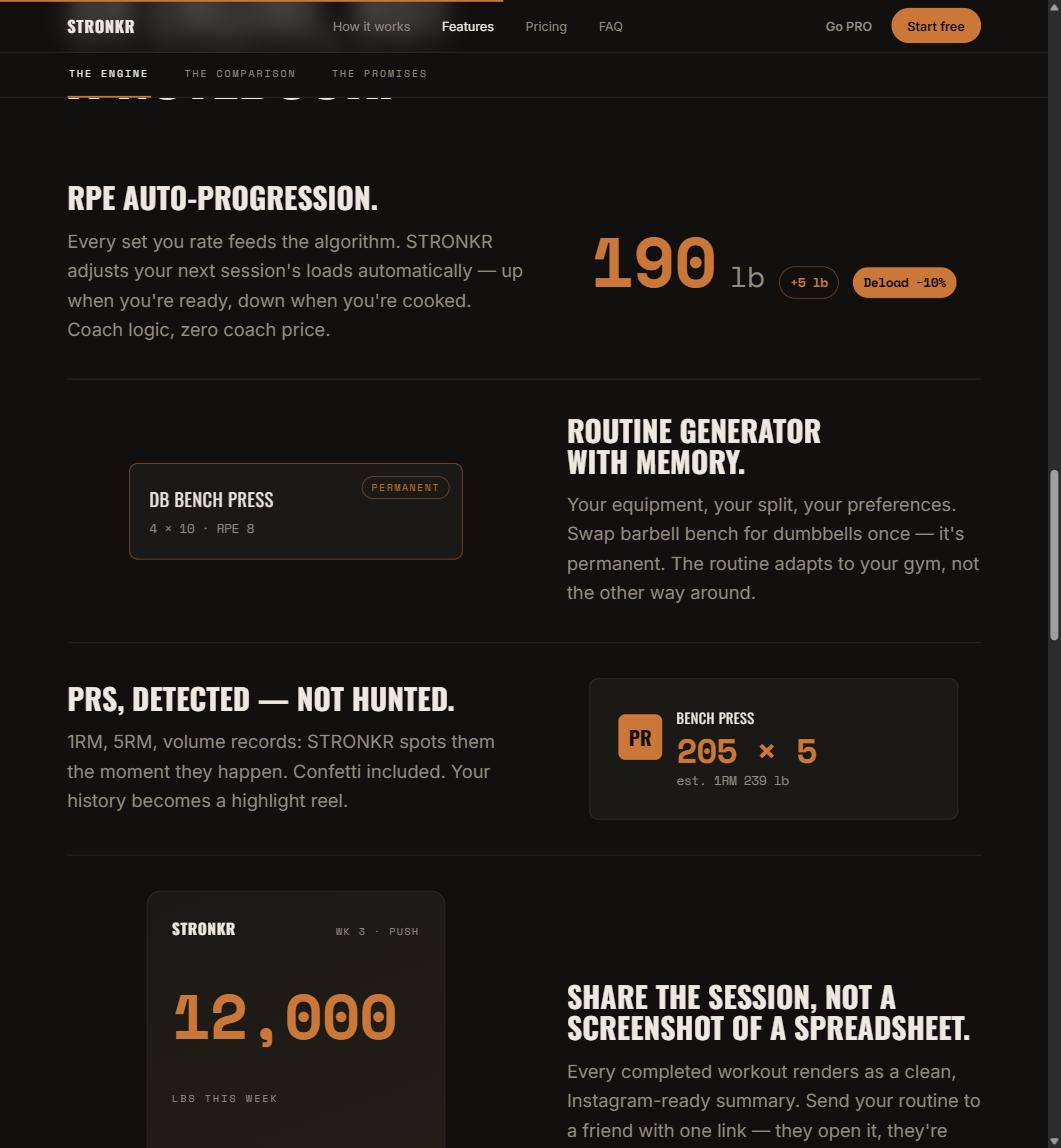
The rating you give each set feeds the algorithm that sets your load the next time that exercise comes up. The outcomes it surfaces are concrete: a target increase such as +5 lb, or Deload -10%. The site puts it plainly, it suggests a deload when your RPE spikes, before you stall, rather than after you have already missed reps for three weeks.
Why spikes matter more than single hard sets
One set at 10 in an otherwise ordinary week is noise. A rating that jumps on a lift you have been rating 7 and 8 for a month is signal, and it is the pattern the engine is watching for. That is the practical argument for keeping your working sets inside the zone: it makes the outliers legible. If deload timing is your specific question, when to deload without guessing goes deeper.
A tracker records that the set happened. The number you assign it is what decides the next one.
Where should each set in a session land?
A reasonable default for an intermediate
Ramp your warm-ups well below 6, put your first working set around 6 or 7, and let the last set of the movement climb to 8 or 9 on the days you have it. Accessories can sit in the same band with less ceremony. If a top set that has been an 8 for a month comes in at 9 or 10 with the same load, that is information, not failure.
Rate the set you did, not the one you wanted
The single most common way an autoregulated program goes wrong is a lifter rating aspirationally: an 8 that was really a 9.5, logged because the number on the bar was supposed to be easy. Accuracy beats optimism here, and it improves quickly with practice, how to rate sets accurately covers the specific checks.
Install Stronkr from the browser at stronkr.com, log one week of honest ratings, and let the next-session targets come from your own data instead of a spreadsheet you maintain at 6am.
Try auto-regulated training
Stronkr reads your RPE after every set and adjusts next session’s load for you. No spreadsheets, no guessing.
Start training with StronkrFrequently asked questions
What does RPE 6 feel like?
On the reps-in-reserve version of the scale, RPE 6 means you could have done roughly four more reps with that load. The bar moves fast, technique holds, nothing grinds. For a lifter with a few years under the bar that is a warm-up, a technique set or deliberate volume, not a top set.
Is an RPE 10 set ever worth doing?
Occasionally. A true maximal set tells you where your ceiling actually is, which is useful before a meet or when a lift has drifted out of calibration. As a default across every working set it costs more recovery than it returns, and the load you can repeat starts falling inside a week or two.
Does Stronkr change my weight mid-workout if I rate a set high?
No. The rating you give feeds the load for your next session, not the set in front of you. If a session goes badly you finish it as programmed or cut it short on your own judgement. The adjustment shows up the next time that exercise comes around.
What if most of my sets land at RPE 5?
Then either the loads are genuinely too light or your ratings are conservative. Check them against the reps-in-reserve definitions: if you could honestly have done five more reps, the bar needs weight. Rate what happened rather than what you hoped, and let the next-session target move.
Do I need to learn RPE before I can use the app?
No. The selector runs 1 to 10, the helper text names the productive zone under it, and a question mark beside the selector opens an in-app explainer. Your ratings get more accurate with practice, and the engine works from whatever you honestly report in the meantime.
Keep reading
Autoregulation for Intermediate Lifters: A Field Guide
Autoregulation training loads the lifter you are today, not the one the spreadsheet predicted. How RPE handles bad sleep, stress and travel weeks.
Evidence-Based, Not AI-Improvised: Where Stronkr's Programming Comes From
An evidence-based workout app should tell you where its logic comes from. Stronkr's progression follows published autoregulation practice, not a chatbot.
How to Rate Your Sets Accurately (and Get Better at It)
How to use RPE without guessing: rate immediately, ask how many reps you had left, and expect to be wrong early. A calibration guide for lifters.