RPE vs RIR: One Idea, Two Scales

The Stronkr Founder Founder, Stronkr
6 min read
On this page
RPE vs RIR is not a debate about which measurement is better. They are the same measurement with the labels running in opposite directions. RIR, reps in reserve, counts what you left in the tank. RPE counts how close you got to your limit. The conversion is one subtraction: RIR equals ten minus RPE.
So an RPE 8 and 2 RIR describe an identical set, and any argument about which is correct is an argument about phrasing. What is worth spending time on is which framing you can answer faster while standing over a barbell, because that is the one that will produce honest numbers from you week after week. This post covers the conversion, where each version reads more naturally, where the arithmetic stops being clean, and why the app logs a 1-10 selector.
Key takeaways
- RIR equals ten minus RPE. RPE 10 is 0 RIR, RPE 9 is 1, RPE 8 is 2, RPE 7 is 3.
- Both describe proximity to failure. Neither describes effort, fatigue, or how heavy the bar looked.
- Counting reps left is usually the faster mental operation; RPE is the more common language in programs and the literature.
- Stronkr records a single 1-10 RPE selector, and thinking in RIR before you tap costs you one subtraction.
What This Looks Like in Stronkr
There is one field, and it takes whichever framing you arrive with.
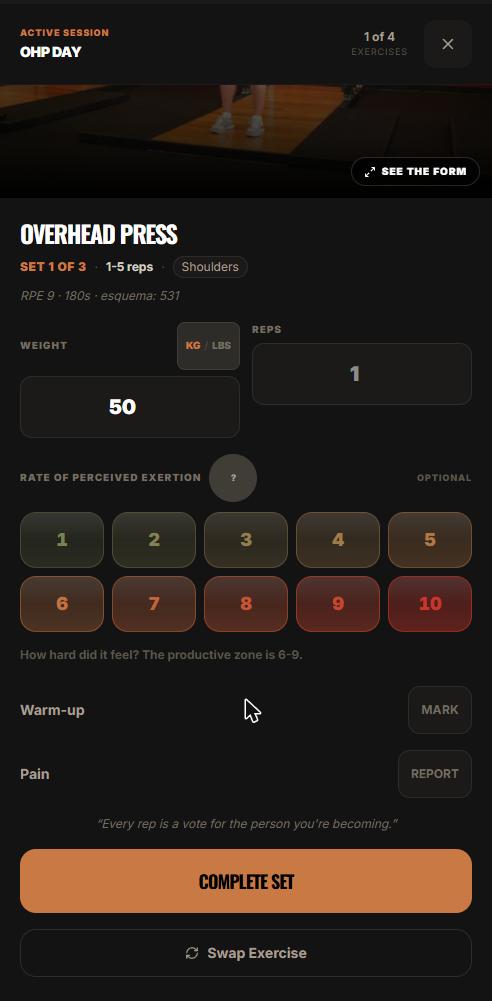
- Finish the set, Overhead Press, Set 1 of 3 on OHP DAY here, and enter the weight and reps you completed, using the KG/LBS toggle to match the plates in front of you.
- Count reps left, if that is how you think. Two more available.
- Subtract from ten and tap 8 on the RPE selector below the fields. It runs 1 to 10, coloured green through red, so the scale’s direction is visible without reading anything.
- Check the helper text if you want the anchor: “How hard did it feel? The productive zone is 6-9.” The
?next to the selector opens the in-app explainer if you need the definitions mid-session. - Tap COMPLETE SET. The number goes to the progression engine, which uses it to set the load for your next session.
Step 2 is optional and invisible to the app. Step 3 is the only thing recorded. If you already think natively in RPE, skip straight to it, the engine reads the same value either way, as covered in how RPE auto-progression works.
RPE and RIR are the same ruler read from opposite ends. Pick the end you can read faster.
How does the conversion actually work?
Subtract from ten, in either direction.
| Reps left | RPE |
|---|---|
| 0 | 10 |
| 1 | 9 |
| 2 | 8 |
| 3 | 7 |
| 4 | 6 |
That covers essentially every working set you will log. The productive zone the app names, 6 to 9, is four reps in reserve down to one, which is the entire useful range for strength work and the range where both scales are precise.
Further down, the clean arithmetic gets theoretical. Nobody reliably distinguishes six reps in reserve from seven, and it does not matter: a set that light is warm-up or technique work, and the exact rating carries no information the engine needs. The scale is sharp where sharpness is useful and vague where vagueness costs nothing.
When is RIR the more natural framing?
When you have just finished a set and need an answer in under five seconds. “How many more could I have done” is a concrete question about a countable thing, and most lifters answer it faster and more consistently than “what number was that”.
It is also the better framing while you are learning, because it forces the question the scale is actually asking. A lifter thinking in RPE can drift into rating how the set felt, the whole failure mode the scale exists to prevent. A lifter thinking in reps left cannot, because reps are not a feeling.
This is not a coincidence of vocabulary. Zourdos MC, et al. (2016), in the Journal of Strength and Conditioning Research, built the resistance-training RPE scale on repetitions in reserve precisely because general effort scales did not transfer to lifting. RIR is the underlying quantity; RPE is the label on it.
When is RPE the more natural framing?
When you are reading a program, talking to a coach, or reading research. Templates say “top set at RPE 8, back-offs at RPE 6”, and the strength literature is written the same way, Helms ER, et al. (2016), in the Strength and Conditioning Journal, published the applied guidance in RPE terms.
It is also more natural at the top of the scale, where the reps-left count stops being an estimate and becomes a judgement about a rep you did not attempt. At RPE 9 versus 10, “one more, probably” and “nothing left” are as much about bar speed and technique breakdown as about counting, and the RPE label handles that ambiguity more gracefully than a rep count does.
Being fluent in both is the practical position. It costs one subtraction and removes any friction when your program is written in one dialect and your head works in the other.
The whole loop, the generator, the logging, the engine, sits on the free tier, so testing which framing you rate more consistently in costs you nothing but a couple of sessions.
Why does Stronkr log RPE rather than RIR?
Three reasons, none of them arbitrary.
One axis, one number
Every set gets a single position on a single 1-10 scale, which is directly comparable across exercises and across months of history. A field that sometimes means “reps left” and sometimes means “a lot” would not be.
It matches the language your program is written in
Programs, coaches and papers speak RPE. Recording in the same dialect means what you read and what you log do not need translating in one direction and back in the other.
It behaves sensibly at the bottom
An RIR field has to accept large, meaningless numbers for warm-up sets. A 1-10 scale collapses that range into “light” without pretending the count is precise, which is exactly right for sets whose job is not to be rated.
The scale is not the interesting part. What happens to the number afterwards is the interesting part.
Does the framing change what the engine does?
No. The engine reads the number on the selector. Whether you got to 8 by subtracting two from ten or by recognising the set as an 8 is invisible to it and irrelevant to the prescription.
What is not irrelevant is honesty and timing. Rate the set immediately, rate the reps rather than the feeling, and expect your calibration to improve over the first few weeks, that habit is worth more than either framing, and it is the subject of rating your sets accurately. If you want the definitions themselves nailed down, what RPE 8 actually means is the shorter answer. And if you want the wider practice this sits inside, autoregulation for intermediate lifters covers why adjusting to the day beats adhering to a percentage chart.
Two names, one measurement, one decision: what goes on the bar next session.
Start free at stronkr.com: unlimited routines, the routine generator, RPE auto-progression, ninety-day history, PR and volume tracking, offline, no credit card. Log in whichever dialect you think in and let the subtraction happen before the tap.
Try auto-regulated training
Stronkr reads your RPE after every set and adjusts next session’s load for you. No spreadsheets, no guessing.
Start training with StronkrFrequently asked questions
What is the difference between RPE and RIR?
Almost none. They are two labels for the same measurement of proximity to failure, running in opposite directions. RIR counts the reps you left in the tank; RPE counts up toward your limit. RIR equals ten minus RPE, so an RPE 8 and 2 RIR describe an identical set.
How do I convert RIR to RPE?
Subtract from ten. Zero reps in reserve is RPE 10, one is 9, two is 8, three is 7. The arithmetic is clean through the top of the scale, which is where nearly all working sets live. Further down it gets looser because nobody reliably distinguishes six reps left from seven.
Which one should I use in my own training?
Whichever you can answer faster after a set. Most lifters estimate reps left more naturally than they estimate a rating, so counting in RIR and converting is a reasonable habit. Programs and coaches more often write in RPE, so being fluent in both costs you one subtraction.
Why does Stronkr use a 1-10 RPE selector instead of an RIR field?
Because a single 1-10 scale gives every set one position on one axis, which matches how programs and the research literature are written, and it handles the bottom of the range where reps-in-reserve counting stops being meaningful. You can still think in reps left and convert before you tap.
Does the progression engine care which framing I think in?
No. It reads the number on the selector. Whether you arrived at 8 by thinking 'two reps left' or by recognising the set as an 8 makes no difference to the load it sets for your next session. What matters is that the number is honest and rated straight after the set.
Keep reading
Autoregulation for Intermediate Lifters: A Field Guide
Autoregulation training loads the lifter you are today, not the one the spreadsheet predicted. How RPE handles bad sleep, stress and travel weeks.
Evidence-Based, Not AI-Improvised: Where Stronkr's Programming Comes From
An evidence-based workout app should tell you where its logic comes from. Stronkr's progression follows published autoregulation practice, not a chatbot.
How to Rate Your Sets Accurately (and Get Better at It)
How to use RPE without guessing: rate immediately, ask how many reps you had left, and expect to be wrong early. A calibration guide for lifters.