Evidence-Based, Not AI-Improvised: Where Stronkr's Programming Comes From
The Stronkr Founder Founder, Stronkr
6 min read
On this page
Any product calling itself an evidence based workout app should be able to tell you exactly where its programming logic came from. The reasonable suspicion in 2026 is that a language model is writing the training and the marketing page is dressing it up afterwards. So here is the direct answer. Stronkr’s progression is not generated by an AI. It is a defined autoregulation rule drawn from established practice in the strength-training literature: you rate each set on RPE, and that rating determines the load prescribed for your next session. The six adaptive programs in the library are structured programs with real frequency, length and constraints, not blank templates you are told to edit. And the AI coach you can see on the pricing page is marked “(coming)”. It has not shipped. This post shows you exactly where the logic comes from and what it does not claim.
Key takeaways
- The progression rule is autoregulation as documented in the strength literature, not a model improvising a session for you.
- Three papers are the reference points: Zourdos 2016, Helms 2016 and Helms 2018. They are cited below with what they actually cover.
- No human coach, trainer or clinician reviews your training. That service does not exist in the product and is not implied anywhere.
- The AI coach is listed as coming on the pricing page. PRO buys first access to it when it ships, not access today.
What This Looks Like in Stronkr
The method is visible in the product rather than described in a whitepaper. You can trace the whole loop in one session.
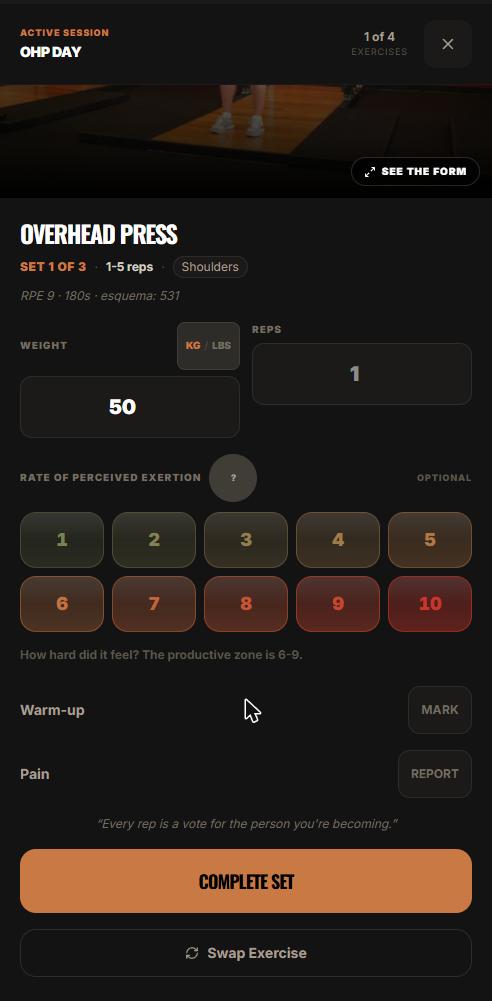
- Complete a set. On the set screen, OHP DAY, Overhead Press, Set 1 of 3 in the app screenshot, you enter weight and reps, with a KG-LBS toggle beside them.
- Rate the set on the RPE selector, which runs 1 to 10 and shades green to red. The helper text underneath reads: “How hard did it feel? The productive zone is 6-9.”
- Tap the question mark next to the selector if you want the in-app explainer for the scale.
- Confirm with the orange COMPLETE SET button. Warm-up MARK and pain REPORT are on the same screen if either applies.
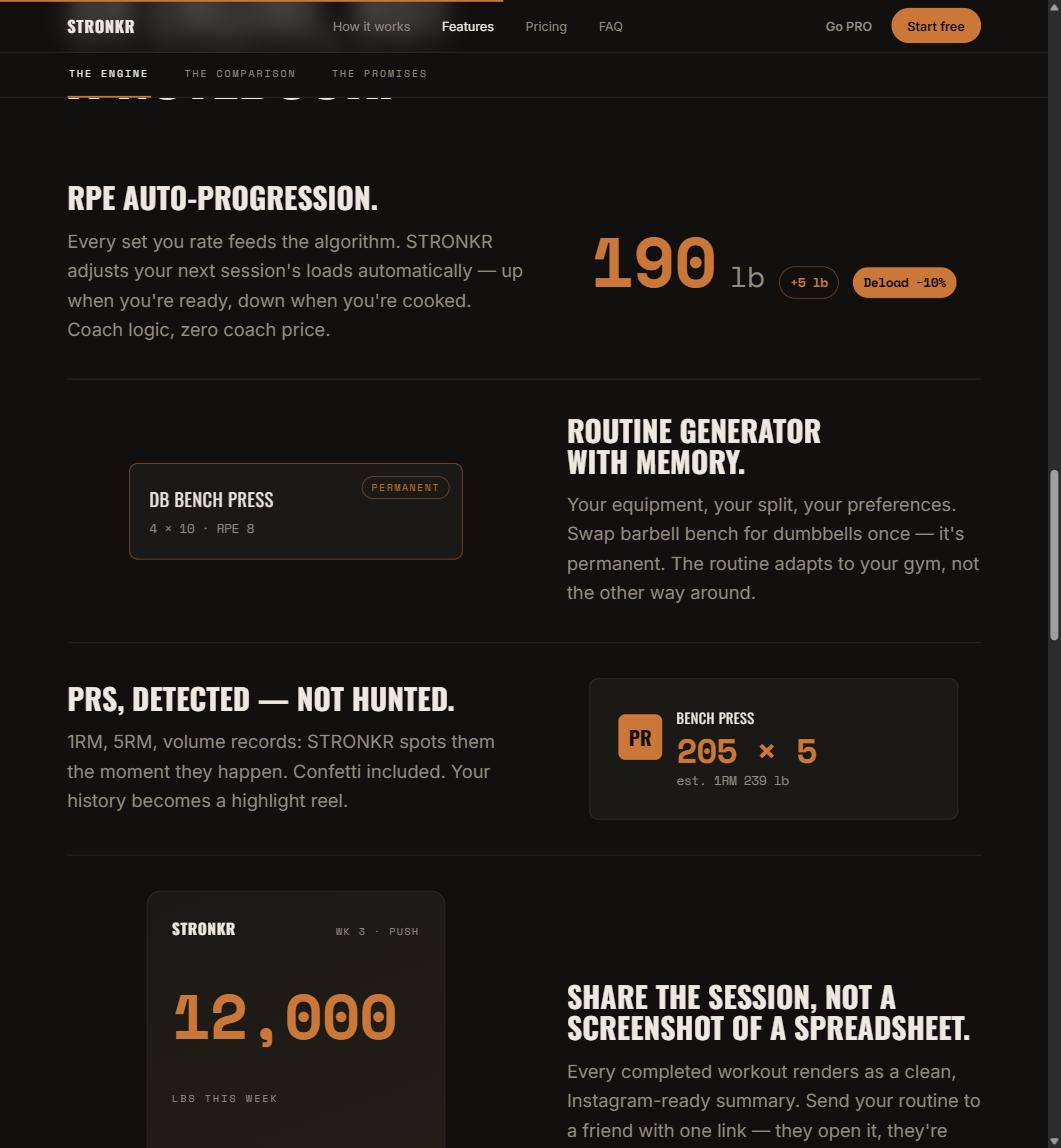
- Next time that exercise comes up, the engine gives you a target: an increase such as +5 lb, or Deload -10%. The site states it suggests a deload when your RPE spikes, before you stall.
That is the entire mechanism. There is no step where a model is asked to be creative, and no step where a person reads your log.
Where does the progression logic come from?
Zourdos 2016, the scale itself
Zourdos MC, et al. (2016). Novel resistance training-specific rating of perceived exertion scale measuring repetitions in reserve. Journal of Strength and Conditioning Research. This is the paper behind the version of RPE that strength training actually uses: a scale anchored to repetitions in reserve rather than to general breathlessness. It is why a rating in Stronkr means something specific about proximity to failure instead of being a mood score.
Helms 2016, how to apply it
Helms ER, et al. (2016). Application of the repetitions in reserve-based rating of perceived exertion scale for resistance training. Strength and Conditioning Journal. An applied paper about using the RIR-based scale to prescribe and adjust resistance training in practice. The productive-zone framing, and the idea that ratings should drive subsequent loading decisions, come from this line of work rather than from anything invented for an app.
Helms 2018, the direct comparison
Helms ER, et al. (2018). RPE vs. percentage 1RM loading in periodized programs matched for sets and repetitions. Frontiers in Physiology. This one compares load prescribed by RPE against load prescribed as a percentage of 1RM, in periodized programs matched for sets and reps. I am not going to hand you an effect size from it, because one trial does not settle how you should load a squat. What it establishes is that RPE-based prescription is a studied method with a serious comparison behind it.
Citing research does not prove an app works. It proves the method was not made up on the spot. Those are different claims and only one of them is defensible.
Does Stronkr use AI or machine learning?
No, and the pricing page says so
The progression is rule-driven. Your RPE rating goes in, a next-session load comes out, and the same input produces the same output every time. There is no model deciding what your training should look like today. The AI coach that appears on the pricing page is explicitly marked “(coming)”, it is not shipped, and the PRO tier lists first access to it as a benefit, which means first in line, not available now.
Why say that out loud
Because the alternative is the failure mode that has poisoned this whole category: a product marketed on a feature that does not exist, discovered by the first person who installs it looking for that feature. If you are paying $4.99 a month, you should know exactly what you are buying. What $4.99 actually buys breaks the tiers down line by line.
You can install the app from the browser and check every claim in this post against the product itself before spending anything. The core is free, with no credit card.
What does “evidence-based” not mean here?
Nobody reviews your training
There is no human coach, no certified trainer and no physiotherapist looking at your log. That service does not exist inside Stronkr and never has. What the app does is the specific job a coach does when they decide what load to put on your bar next session, what RPE auto-progression is covers that mechanism in full. It does not do the parts that require a person watching you lift.
The joint-friendly programs are programming, not treatment
Lower-Back Friendly, Knee-Friendly Lower Body and Shoulder-Friendly Upper Body are programming accommodations built around a constraint. They are not rehabilitation, they are not diagnosis, and they are not clinically prescribed. If something hurts in a way that needs a clinician, see one. The app’s contribution is training around the problem, not treating it.
Evidence does not mean guaranteed
Research supports autoregulation as a way to select load. It does not promise you a number on your total by March. Anyone selling you a specific outcome from an app is describing a result they cannot control, which is why you will not find one on the site.
Are the six adaptive programs actually programmed?
Six programs, shipped as programs
Postpartum Return to Lifting, Masters 40+ Strength, Comeback Program, Lower-Back Friendly, Knee-Friendly Lower Body and Shoulder-Friendly Upper Body all exist in the library as first-class programs with their own frequency, length and constraints. Postpartum and Masters 40+ run two to three days a week with structured recovery built in. The full breakdown of all six walks through each one.
The difference between a program and a template
A template hands you a generic block and tells you which parts to change for your situation, which puts the programming work back on you, the exact work the spreadsheet was already doing. A shipped program has the constraint designed in before you open it. That distinction is the entire argument, and it is checkable in about a minute in the app.
The honest version of “professionals, not just AI” is: a documented method, applied consistently, with the parts that do not exist named as not existing.
How do you verify any of this yourself?
Read the three papers
They are real, findable and not behind a marketing wall. If the progression logic behaves in a way the literature does not support, that is a bug worth reporting, not a mystery.
Check the changelog and the product
Stronkr launched in early access in July 2026, and the changelog at stronkr.com/changelog has a single entry to show for it. A two-month-old product with one changelog entry and no user-count claims is telling you what it is. The features described in this post are all visible in the app, and why the productive zone is 6-9 explains the one number the whole loop runs on.
Install Stronkr free at stronkr.com, run a week, and check the next-session targets against the ratings you gave. If the logic does not hold up, you will have lost nothing but a week of honest rating practice.
Try auto-regulated training
Stronkr reads your RPE after every set and adjusts next session’s load for you. No spreadsheets, no guessing.
Start training with StronkrFrequently asked questions
Does Stronkr use AI to write my program?
No. The progression follows a defined autoregulation rule: you rate each set, and that rating sets the load for your next session. The AI coach listed on the pricing page is marked coming and has not shipped. PRO buys first access to it when it exists, not the feature today.
Does a real coach or physio review my training?
No, and no part of the product implies otherwise. There is no human review service, no certified trainer checking your log, and no clinician signing off on the joint-friendly programs. Those programs are programming accommodations built around a constraint, not medical care or rehabilitation.
Which research is the progression based on?
Three papers: Zourdos and colleagues (2016) on the repetitions-in-reserve RPE scale, Helms and colleagues (2016) on applying that scale in resistance training, and Helms and colleagues (2018) comparing RPE and percentage-1RM loading in periodized programs matched for sets and reps.
Does citing studies mean the app is proven to work?
No. It means the method is a documented one rather than an invention. Published research supports autoregulation as a way to prescribe load; it does not prove any particular app produces a given result for you. Anyone claiming otherwise is selling you something.
Are the six adaptive programs real programs or editable templates?
They ship as first-class programs in the library, with their own frequency, length and constraints. Postpartum Return to Lifting and Masters 40+ Strength run two to three days a week with structured recovery. You are not handed a generic block and told which parts to rewrite.
Keep reading
Autoregulation for Intermediate Lifters: A Field Guide
Autoregulation training loads the lifter you are today, not the one the spreadsheet predicted. How RPE handles bad sleep, stress and travel weeks.
How to Rate Your Sets Accurately (and Get Better at It)
How to use RPE without guessing: rate immediately, ask how many reps you had left, and expect to be wrong early. A calibration guide for lifters.
RPE vs Percentage-Based Training on a Bad Day
RPE vs percentage training comes down to what happens when you show up under-slept. One method adapts to the day, the other assumes a max from weeks ago.