Autoregulation for Intermediate Lifters: A Field Guide

The Stronkr Founder Founder, Stronkr
6 min read
On this page
Autoregulation training means adjusting what you lift to the lifter who showed up today, rather than to the one a spreadsheet predicted three weeks ago. For an intermediate that distinction stops being academic somewhere around year three, when the linear runway is gone and the difference between a good week and a bad one is worth ten percent on a top set. Fixed percentages assume your capacity is a constant. It is not: sleep, stress, travel and the last session all move it. This is a working guide to autoregulating without turning every session into an argument with yourself, what the method is, what it fixes, what it does not, and how RPE-driven load selection handles the weeks that break a written plan.
Key takeaways
- Autoregulation adjusts load to today’s capacity. RPE is the practical way to measure that capacity without lab equipment.
- A fixed percentage is a prediction made weeks ago about a body that has since slept badly, flown somewhere and worked late.
- The rating is not a mood score. It is anchored to reps in reserve, which is what makes it usable as an input.
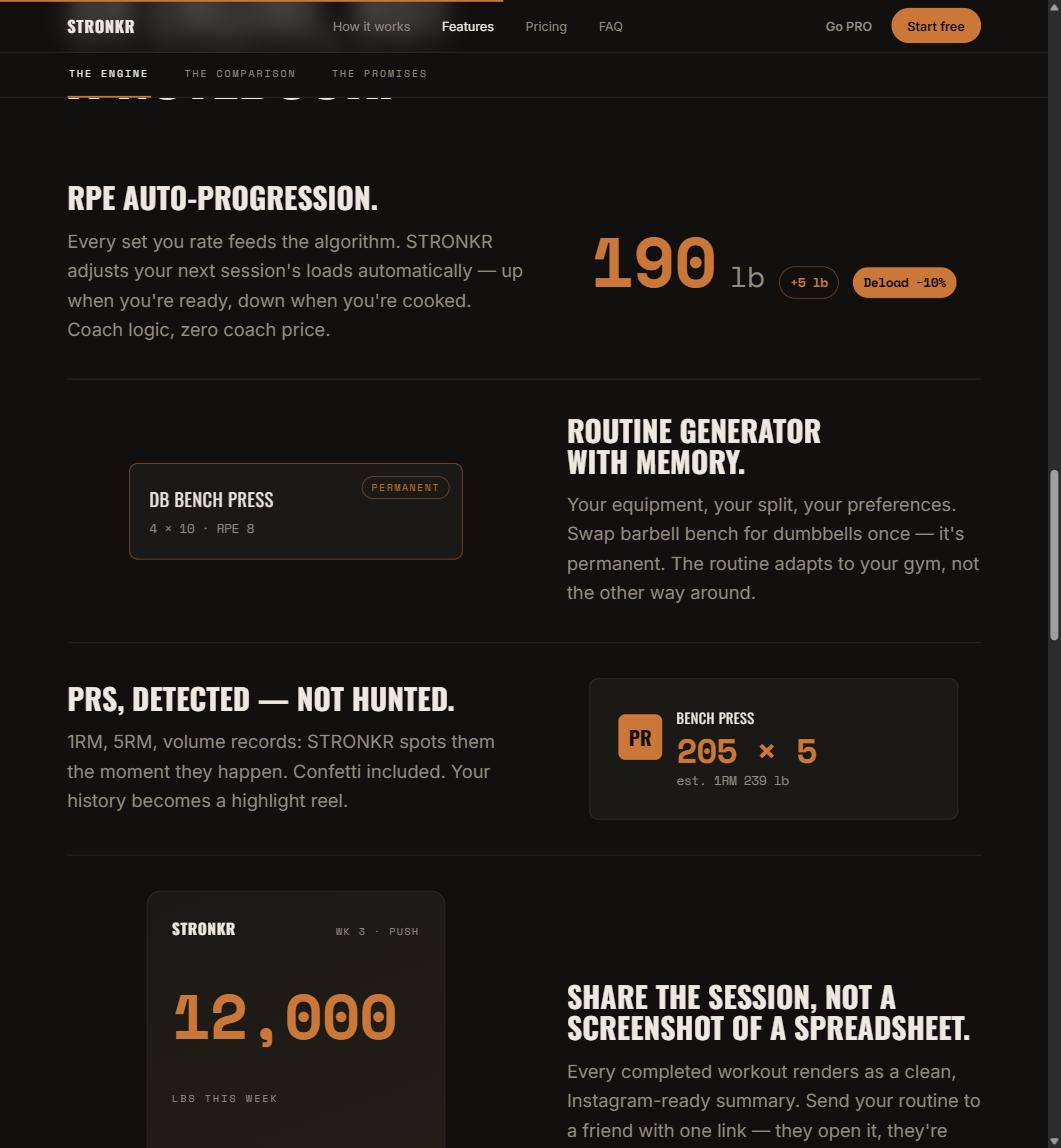
- In Stronkr the loop is closed: you rate each set, and the engine sets your next session’s load from those ratings.
What This Looks Like in Stronkr
Autoregulation is only useful if something acts on the rating. In Stronkr the section above describes the loop, and the app runs it in four steps.
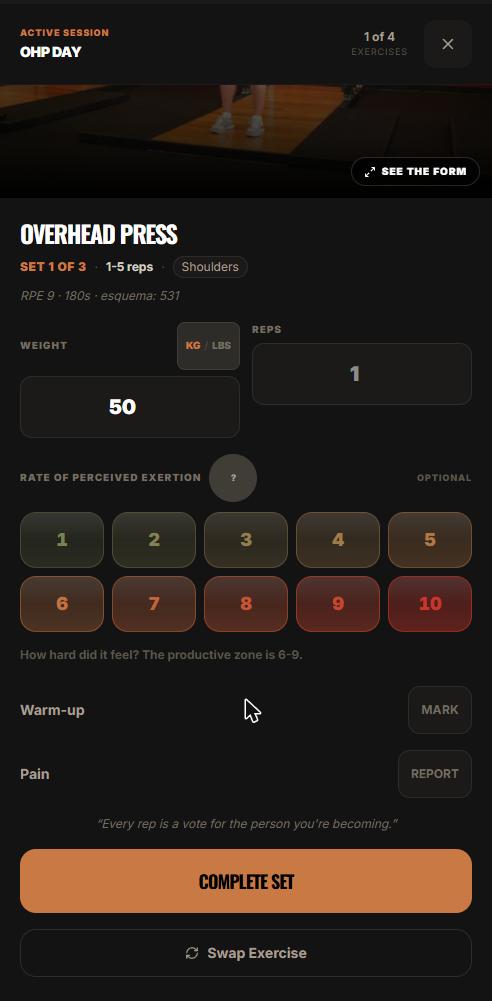
- Log the set as you finish it, weight and reps, with a KG-LBS toggle if you train in the other unit.
- Rate the set on the RPE selector, which runs 1 to 10 and shades from green to red. The helper text underneath reads: “How hard did it feel? The productive zone is 6-9.”
- Tap the question mark beside the selector for the in-app explainer if you want the anchor points in front of you while you decide.
- Complete the set with the orange COMPLETE SET button. Warm-up MARK and pain REPORT sit on the same screen when either is relevant.
The next time that exercise comes around, the engine prescribes a target: an increase such as +5 lb, or Deload -10%. The site’s own line is that it suggests a deload when your RPE spikes, before you stall. Nothing changes mid-workout, the adjustment lands on your next session, which is what makes it a programming decision rather than a reaction.
What is autoregulation, precisely?
A feedback loop, not a philosophy
Autoregulation is the practice of letting measured performance or perceived effort determine the next training prescription. The loop has three parts: a planned session, a signal from how that session actually went, and a rule that turns the signal into the next prescription. Take away the rule and you have a training diary with feelings in it.
Why RPE became the standard signal
Bar speed trackers and force plates measure readiness more precisely and cost more than most people’s rack. The reps-in-reserve version of RPE gives you a signal accurate enough to load from, using nothing but attention: a set rated 8 means roughly two reps were left, and that is a claim about proximity to failure rather than about how motivated you felt. What RPE auto-progression is covers how that signal becomes a number on the bar.
A plan written three weeks ago is a hypothesis about today. Autoregulation is what happens when you check it.
Why do fixed percentages break on a bad day?
They encode a max you no longer have
Percentage-based loading anchors everything to a one-rep max measured on a specific day. Every prescription downstream inherits that day’s conditions. If the max was tested fresh at the end of a deload and you are now in week four of a block after two bad nights, 80 percent on paper can be 88 percent in the rack, and the session prescribed as moderate becomes a maximal effort by accident.
The failure is silent
A percentage does not announce that it has drifted. You simply miss reps, attribute it to a bad session, and repeat the same load next week because that is what the sheet says. Two or three weeks of that reads as a plateau but is really an untracked mismatch between the prescription and your current capacity. The full comparison is in RPE vs percentage-based training on a bad day.
They also break upward
The failure runs in both directions. On the weeks when everything works, a fixed percentage caps you at a number that was conservative when it was written, and you leave progress on the floor because the plan cannot tell that you had a good day.
If you want to see what a rated week looks like against your own history, the core of Stronkr is free from the browser with no credit card and no App Store detour.
How does autoregulation handle sleep, stress and travel?
Bad sleep shows up as a rating, not as a missed rep
You do not need to quantify why capacity dropped. A night of four hours makes the same load feel heavier, you rate it accordingly, and the next-session target reflects the rating. The mechanism is indifferent to the cause, which is exactly what you want from something that has to work during a bad month rather than an ideal one.
Stress compounds quietly and the ratings catch it
A hard work period rarely produces one obviously terrible session. It produces four sessions where the top set creeps from 8 to 9 with the same weight on the bar. That drift is the signal. It is also invisible in a tracker that records only weight and reps, because the numbers look identical week to week while the cost of producing them has doubled.
Travel weeks are a load problem, not a discipline problem
A hotel basement with three dumbbells is not the gym the plan assumed. Rating what you actually did keeps the record honest, and the constraint gets handled by substitution rather than by pretending the session did not happen. Autoregulation is what stops a two-week trip from resetting your programming.
The tracker records that the set happened. Autoregulation is the part that decides what it means.
What autoregulation does not fix
It will not rescue a bad program
If your structure is wrong, no organising principle, random exercise selection, volume that has never been planned, autoregulating the load only makes the wrong sessions better calibrated. Autoregulation is a loading method layered on a program. It is not the program.
It is not real-time and should not be
The adjustment applies to your next session, not the set in front of you. That is deliberate: a single rating is noisy, and reacting to it mid-workout amplifies noise instead of trend. Deload timing works the same way, a spike matters, one hard set does not, and when to deload without guessing covers where that line sits.
It depends entirely on honest ratings
Rate aspirationally and the system inherits your optimism. The most common version is logging an 8 on a set that was clearly a 9.5, because the plan said the weight should have been moderate. Accuracy is a skill, it improves in weeks, and why the productive zone is 6-9 gives you the range to calibrate against.
Install Stronkr free at stronkr.com, rate every working set for one block, and let the next-session targets come out of your own data instead of a percentage you calculated in a spreadsheet last month.
Try auto-regulated training
Stronkr reads your RPE after every set and adjusts next session’s load for you. No spreadsheets, no guessing.
Start training with StronkrFrequently asked questions
What is autoregulation in strength training?
Adjusting training variables to your actual capacity on the day instead of following numbers fixed weeks in advance. In practice it usually means selecting load by perceived effort, rating each set on RPE and letting those ratings decide what the next session prescribes.
Is autoregulation only for advanced lifters?
No, but it needs a baseline. You have to know roughly what two reps in reserve feels like, which takes a few months of honest rating. Someone three years into training who can already tell a hard set from a maximal one has everything the method requires.
Does autoregulation mean I train less when I feel bad?
Sometimes, and that is the point. On a bad day the same load reads as a higher effort, so the next session's target reflects it. What autoregulation prevents is grinding through fixed numbers for three weeks and calling the resulting stall a plateau.
Can I autoregulate and still run 5/3/1 or a similar template?
Yes. Many lifters keep a template's structure and use RPE to decide the working load and whether to push a set. The conflict only appears when a template's prescribed percentage says one thing and your rating clearly says another, which is a decision you have to make.
How long before autoregulated progression shows results?
Expect a few weeks before your ratings are consistent enough to trust, and a full training block before the load targets look obviously different from what you would have written yourself. The method is not fast. It is durable across weeks where fixed numbers break.
Keep reading
Evidence-Based, Not AI-Improvised: Where Stronkr's Programming Comes From
An evidence-based workout app should tell you where its logic comes from. Stronkr's progression follows published autoregulation practice, not a chatbot.
How to Rate Your Sets Accurately (and Get Better at It)
How to use RPE without guessing: rate immediately, ask how many reps you had left, and expect to be wrong early. A calibration guide for lifters.
RPE vs Percentage-Based Training on a Bad Day
RPE vs percentage training comes down to what happens when you show up under-slept. One method adapts to the day, the other assumes a max from weeks ago.