RPE vs Percentage-Based Training on a Bad Day

The Stronkr Founder Founder, Stronkr
6 min read
On this page
The RPE vs percentage training debate is boring on a good day. You slept, you ate, nothing hurts, and 82.5 percent of your tested max feels exactly like the RPE 8 the program wanted. The methods agree and the argument is theoretical. The debate becomes real on a Tuesday after four hours of sleep and a flight, when 82.5 percent is still 82.5 percent on the sheet and is now a maximal effort in the rack. One method has a mechanism for noticing that. The other does not, and will not notice for another three weeks, at which point you will call it a plateau. Here is what each one actually does when your capacity has moved.
Key takeaways
- A percentage is anchored to a max you tested on one specific day. RPE is anchored to the effort of the set you just did.
- The bad-day failure of percentages is silent: you miss reps, blame the session, and repeat the same load next week.
- Helms 2018 compared the two prescription methods directly, in periodized programs matched for sets and reps. It is a serious comparison, not a coronation.
- In Stronkr the rating is the input and the next session’s load is the output, a target increase, or a deload when your RPE spikes.
What This Looks Like in Stronkr
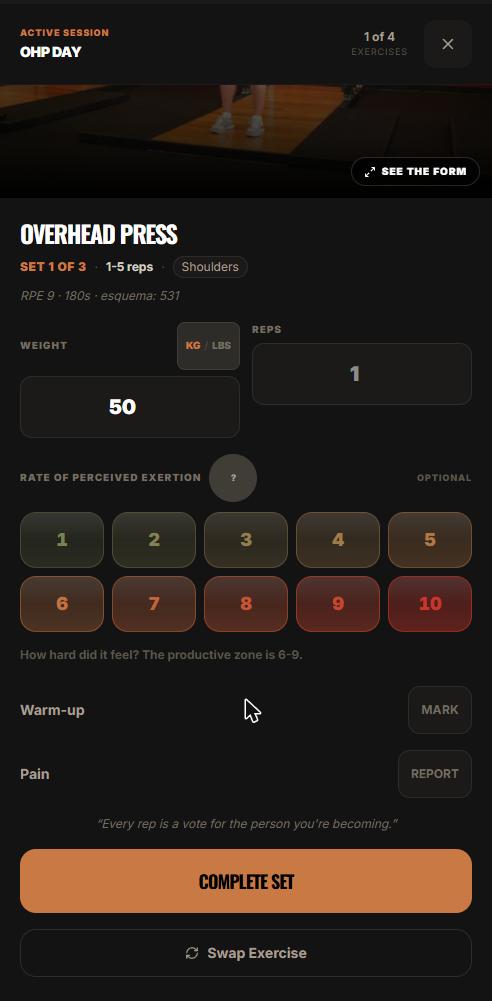
There is no percentage field to maintain. The prescription comes from what you report about the set.
- Log the set on the set screen, the screenshot shows OHP DAY, Overhead Press, Set 1 of 3, entering weight and reps, with the KG-LBS toggle beside them.
- Rate it on the RPE selector, which runs 1 to 10 and shades green to red as the effort climbs.
- Check the helper text under the selector if you are new to the scale: “How hard did it feel? The productive zone is 6-9.”
- Open the in-app explainer from the question mark next to the selector when you want the anchor points in front of you.
- Confirm with the orange COMPLETE SET button. Warm-up MARK and pain REPORT are on the same screen when either applies.
- Next time that exercise appears, the engine gives you a load target: an increase such as +5 lb, or Deload -10%.
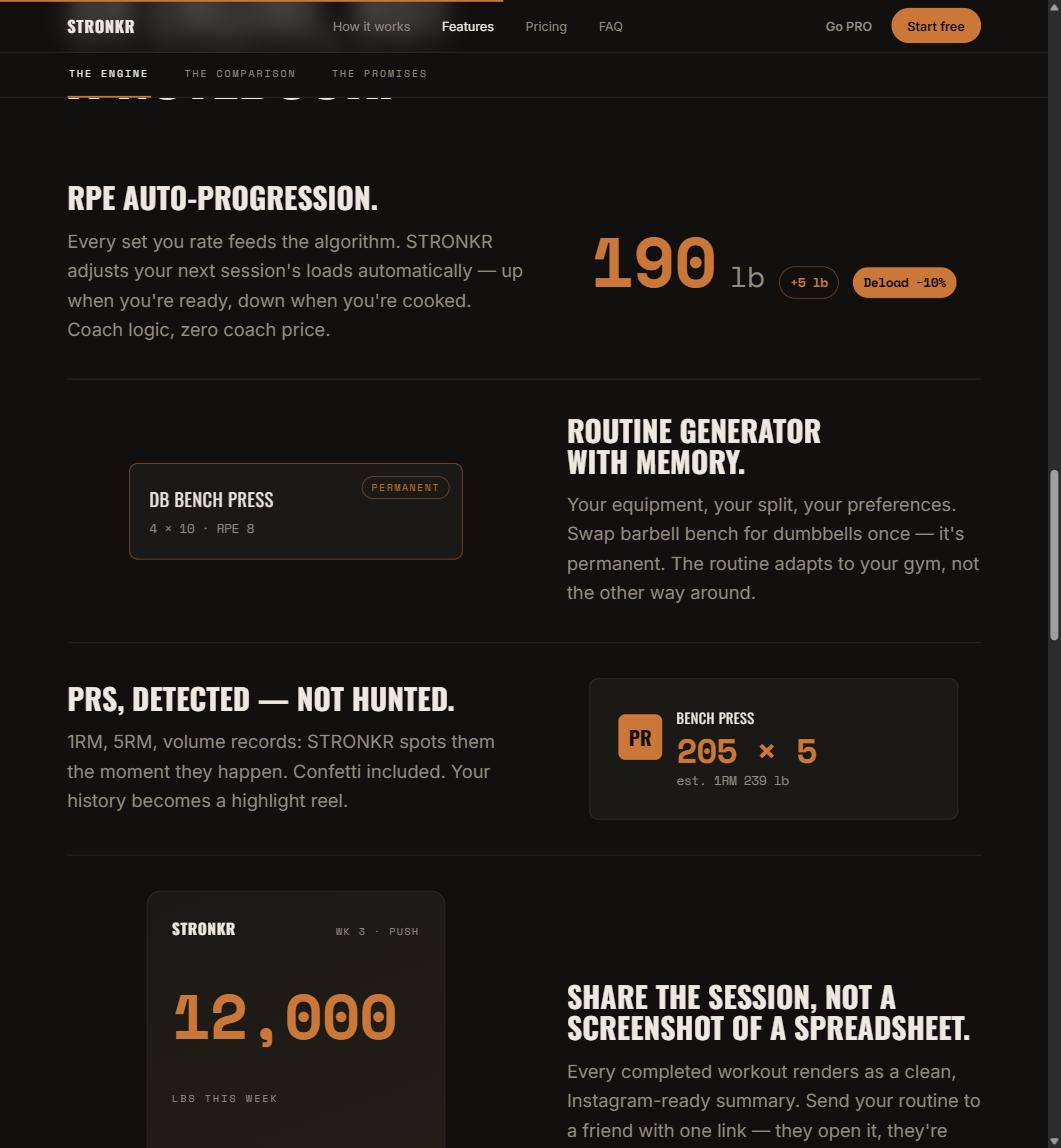
That target is computed from your ratings, not from a maximum you tested in October. Stronkr also detects PRs automatically, one-rep max, five-rep max, volume and estimated one-rep max, so your best numbers stay current without a testing day.
What does percentage-based loading assume?
That your max is a property of you, not of a day
Percentage prescription treats one-rep max as a stable attribute. It is closer to a snapshot: the number you produced under the conditions of one afternoon, with that week’s sleep, that month’s stress, and the deload that preceded the test. Everything downstream inherits those conditions, quietly, for the length of the block.
That the block will go as written
Percentages are a plan, and plans assume continuity. Twelve weeks without a bad night, a work crisis, a travel week or a cranky joint is not a training block, it is a hypothetical. The prescription has no way to register that any of those happened.
A percentage is a prediction. An RPE rating is an observation. The gap between them is where a training block quietly goes wrong.
What did Helms 2018 actually compare?
The design
Helms ER, et al. (2018). RPE vs. percentage 1RM loading in periodized programs matched for sets and repetitions. Frontiers in Physiology. The comparison is between two ways of choosing the load, by rating of perceived exertion, or as a percentage of one-rep max, inside periodized programs matched for sets and repetitions. Matching the set and rep work is the part that matters, because it isolates the prescription method instead of testing who did more volume.
What it does not settle
One trial does not decide how you should load a squat, and you will not find an effect size quoted here. Treat it as evidence that RPE-based prescription is a studied, comparable method rather than something an app invented. The supporting work is older and more foundational: Zourdos MC, et al. (2016) established the repetitions-in-reserve RPE scale in the Journal of Strength and Conditioning Research, and Helms ER, et al. (2016) covered applying that scale in practice in the Strength and Conditioning Journal.
Why the honest reading is the useful one
Anyone telling you the research proves percentages are obsolete is overselling a literature that does not say that. The defensible claim is narrower and still decisive for an intermediate: load selected by effort responds to the day, and load selected by percentage cannot. Where the programming logic comes from is worth reading if you want the mechanism rather than the argument.
What happens to each method on a bad day?
The percentage version
You arrive under-slept. The sheet says 5 sets of 3 at 82.5 percent. Set one is grindy, set three drops to a double, and you finish something that was planned as moderate and delivered as maximal. Next week the sheet says 85 percent, because the sheet does not know. The stall arrives two weeks later with no explanation attached.
The RPE version
You arrive under-slept, take the same opening weight, and it rates a 9 instead of the 7 it usually is. You have learned something on the spot, the session is recorded honestly, and the next-session target reflects it rather than pretending the week did not happen. How autoregulation handles those weeks goes through sleep, stress and travel specifically.
The difference is not the workout, it is the next one
Both lifters had a bad Tuesday. Only one of them has a system that noticed. That is the entire practical difference, and it compounds across a block: three unnoticed overshoots become a stall, and three noticed ones become a deload suggested before the stall.
The stall is rarely the day you missed the reps. It is the three weeks after it, when nothing in the plan noticed.
If you want to test this on your own lifts rather than take my word for it, the core of Stronkr is free from the browser, no credit card and no App Store.
Can you run both?
Percentages for structure, ratings for the day
Nothing stops you keeping a template’s shape and using RPE to decide the working load. 5/3/1 with the top set taken to a rated effort is a common and sane way to run it. The percentage gives you a starting point that is roughly right; the rating tells you whether roughly right was right today.
When they disagree, the rating is the newer information
If a prescribed percentage says moderate and the set rates a 9.5, the percentage is stale, not the rating, assuming the rating is honest, which is the load-bearing assumption of the whole method. What RPE 8 actually means is the calibration check worth running before you trust your own numbers.
The tiebreaker for an intermediate
If you are three to five years in, training three or four times a week, and moving between a commercial gym, a garage rack and whatever the hotel has, the fixed-percentage assumption breaks more often than it holds. Default to ratings, keep percentages as a sanity check, and put your working sets in the range described in why the productive zone is 6-9.
Install Stronkr free at stronkr.com, rate one block honestly, and compare the next-session targets it produces against the percentages you would have written yourself.
Try auto-regulated training
Stronkr reads your RPE after every set and adjusts next session’s load for you. No spreadsheets, no guessing.
Start training with StronkrFrequently asked questions
Is RPE better than percentage-based training?
Better is the wrong frame. Percentages are precise about a max you measured once; RPE is responsive to the capacity you have today. On a good day the two land in similar places. On a bad day they diverge sharply, and that divergence is the whole argument.
What did Helms 2018 actually compare?
It compared load prescribed by RPE against load prescribed as a percentage of one-rep max, in periodized programs matched for sets and repetitions. Matching the set and rep work is what makes it a fair test of the prescription method rather than of training volume.
Can I use percentages and RPE together?
Yes, and most experienced lifters do. Use the percentage to set a starting point for the session and the rating to decide whether that number was right. When the two disagree badly and repeatedly, the percentage is the one that has gone stale.
How often do I need to retest my one-rep max with RPE?
You do not have to, which is one of the practical arguments for it. Load comes from ratings rather than from a tested maximum, and Stronkr detects PRs automatically as they happen, including estimated one-rep max, so the number updates without a dedicated testing day.
What do I do when RPE says stop and the program says four more sets?
Finish the session as your own judgement dictates, and rate honestly. Stronkr applies the adjustment to your next session rather than mid-workout, so the answer shows up as a load target next time rather than as an argument with yourself between sets.
Keep reading
Autoregulation for Intermediate Lifters: A Field Guide
Autoregulation training loads the lifter you are today, not the one the spreadsheet predicted. How RPE handles bad sleep, stress and travel weeks.
Evidence-Based, Not AI-Improvised: Where Stronkr's Programming Comes From
An evidence-based workout app should tell you where its logic comes from. Stronkr's progression follows published autoregulation practice, not a chatbot.
How to Rate Your Sets Accurately (and Get Better at It)
How to use RPE without guessing: rate immediately, ask how many reps you had left, and expect to be wrong early. A calibration guide for lifters.