RPE 8 Doesn't Mean 'Hard.' It Means Two Reps Left.

The Stronkr Founder Founder, Stronkr
6 min read
On this page
What does RPE 8 mean? It means two reps in reserve: you could have completed two more reps with that weight before failing. That is the whole definition. Not “hard”, not “heavy”, not “a good set”, a count of what you left on the bar.
Everything else about the scale follows from that. RPE 9 is one rep left. RPE 10 is nothing left. RPE 7 is three. The number is an estimate of a quantity, which is why it can be used as an input to a progression decision and why “that felt hard” cannot. Below is the full scale, the zones that matter, and the reason a rating built on effort rather than reps is worthless to any system that has to do something with it.
Key takeaways
- RPE 8 means two reps in reserve. The scale counts reps left, not effort spent.
- Reps in reserve equals ten minus your RPE at the top of the scale: 9 is one left, 10 is none.
- “Hard” is not a rating. It is a feeling with no quantity attached, and nothing can be calculated from it.
- Stronkr’s set screen calls 6-9 the productive zone, which is where most working sets should land.
What This Looks Like in Stronkr
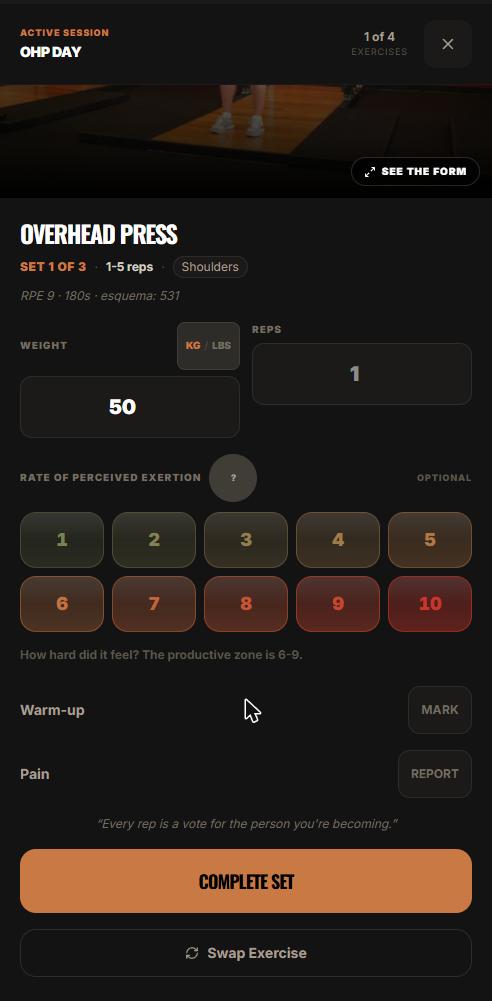
The scale is not something you read about and then apply from memory. It is a control on the set screen.
- Finish the set, here, Set 1 of 3 of Overhead Press on OHP DAY, and enter the weight and reps you actually completed.
- Look at the RPE selector below the fields. It runs 1 to 10, coloured green through red, so the direction of the scale is visible before you know the definitions.
- Read the helper text underneath: “How hard did it feel? The productive zone is 6-9.” That is the expectation for a working set, on screen, every time.
- Tap the
?next to the selector if you want the definitions. It opens the in-app RPE explainer, so you are not leaving the session to look up what an 8 is. - Pick your number and tap COMPLETE SET. The rating is now an input to the load for your next session.
That last step is why the definition has to be precise. The rating is not a note to yourself, it is the value the engine reads when it decides what goes on the bar next time, as described in how RPE auto-progression works.
A number you can only feel is a number nothing can be calculated from.
Why does the scale count reps instead of measuring effort?
Because reps in reserve is a quantity two different lifters, or the same lifter on two different days, will estimate roughly the same way. Effort is not.
This is not a convention someone invented for an app. Zourdos MC, et al. (2016), in the Journal of Strength and Conditioning Research, introduced a resistance-training-specific RPE scale anchored to repetitions in reserve precisely because general effort scales borrowed from endurance work did not map onto lifting. Helms ER, et al. (2016), in the Strength and Conditioning Journal, then laid out how to apply that scale in practice.
The anchoring is what makes it useful. “Hard” depends on your caffeine, your week and your tolerance for discomfort. “Two more reps were available” depends on the bar.
What do the RPE zones actually cover?
RPE 1-4: light
More reps left than you would bother counting. This is warm-up and technique territory, loads you could repeat all afternoon. Rating within this band precisely is pointless, which is why nobody agonises over whether a bar-only set was a 2 or a 3.
RPE 5-7: moderate
Three to five reps in reserve. Real work, comfortably short of failure. Most volume and accessory work lives here, and the top of this band, RPE 7, three reps left, is where a lot of productive training sits without ever feeling dramatic.
RPE 8-9: hard and controlled
Two reps left, then one. This is where most top sets in a strength program belong. The set is unmistakably difficult, bar speed has dropped, and you still finished it without the last rep turning into a grind you had to fight for.
RPE 10: maximal
Nothing left. You could not have completed another rep with that weight and that technique. It is a legitimate rating and occasionally a legitimate target, but a program where most sets land here is a program buying fatigue it cannot use.
The gap between an 8 and a 10 is two reps. The gap in recovery cost is much larger than two reps.
Why is ‘hard’ a useless input for an algorithm?
Because it has no units and no direction. Feed a system “hard” and it has three questions it cannot answer: hard compared to what, hard by how much, and hard in which direction should the load move.
RPE 8 answers all three at once. It says the load was two reps short of your limit today, which means there is room, which means an increase is defensible. RPE 10 says there was no room, which means the honest next move is to hold or back off. That is a decision rule, and it works because the input is a number with a definition rather than an adjective.
This is also why the field cannot be skipped and treated as optional. A tracker that records weight and reps has an archive. A system that records weight, reps and proximity to failure has enough to prescribe. The extra field is the entire difference, and it is the reason rating your sets accurately matters more than any other habit in the loop.
If you want to see what a rating turns into, the progression engine sits on the free tier, a week of rated sessions is enough to watch the loads respond.
Why does the app say 6-9 rather than 8-10?
Because 6-9 is where a well-built session actually lands, and 8-10 is where lifters put themselves when they mistake fatigue for progress.
A session is not one set. Early working sets and accessories at RPE 6 or 7 are doing exactly what they should. Top sets at 8 or 9 are where the stimulus concentrates. The band is wide because sets have different jobs, and a program that rates everything at 9 has flattened that structure into one long grind. There is more on this in why the productive zone is 6 to 9.
The band also has a ceiling for a reason. Ten is available on the selector, and it is a real rating you should use when it is true, but a run of tens is the signal for the engine to call a deload rather than an increase.
What if you are not confident in your number yet?
Rate anyway. Being approximately right is worth far more than skipping the field, because a skipped field gives the engine nothing to work with and quietly turns the app back into a tracker.
Accuracy improves with reps, in both senses. The reliable calibration question is “how many more could I have done”, asked immediately after racking the bar and answered before you start negotiating with yourself. If you want the arithmetic in the other direction, reps in reserve first, RPE second, that framing is covered in RPE vs RIR, and it is the same scale either way.
The scale is not a test you have to pass before training. It is a field you get better at filling in.
Start free at stronkr.com: unlimited routines, the routine generator, RPE auto-progression, ninety-day history, PR and volume tracking, offline, no credit card. Rate one session honestly and the definition of RPE 8 stops being theoretical.
Try auto-regulated training
Stronkr reads your RPE after every set and adjusts next session’s load for you. No spreadsheets, no guessing.
Start training with StronkrFrequently asked questions
What does RPE 8 mean in a strength program?
It means two reps in reserve: you could have completed two more reps with that weight before failing. It is a count of what you left on the bar, not a description of how the set felt. A set of five at RPE 8 is a set where eight reps were available.
Is RPE 8 the same as 80 percent of my one-rep max?
No. Percentage is a fraction of a fixed maximum; RPE is proximity to failure today. Your true maximum moves with sleep, stress and fatigue, so the same percentage can be an RPE 7 one week and an RPE 9 the next. RPE reads the day, percentage reads the calendar.
What is the difference between RPE 8 and RPE 9?
One rep. RPE 9 means one rep in reserve and RPE 8 means two. That single rep is the difference between hard productive work and work that is close enough to failure to cost you meaningful recovery, which is why the distinction is worth rating carefully.
Should every working set be an RPE 8?
No. Stronkr's set screen calls 6-9 the productive zone, which is deliberately wider than a single number. Early sets in a session and accessory work often sit at 6 or 7. Reserving 8 and 9 for top sets is normal programming, not a compromise.
What if I genuinely cannot tell how many reps I had left?
Expect that early and rate anyway. The scale improves with use, and a rough rating beats a skipped field because a skipped field gives the progression engine nothing. Test yourself occasionally by taking a set past the number you would have called and seeing whether you were right.
Keep reading
Autoregulation for Intermediate Lifters: A Field Guide
Autoregulation training loads the lifter you are today, not the one the spreadsheet predicted. How RPE handles bad sleep, stress and travel weeks.
Evidence-Based, Not AI-Improvised: Where Stronkr's Programming Comes From
An evidence-based workout app should tell you where its logic comes from. Stronkr's progression follows published autoregulation practice, not a chatbot.
How to Rate Your Sets Accurately (and Get Better at It)
How to use RPE without guessing: rate immediately, ask how many reps you had left, and expect to be wrong early. A calibration guide for lifters.