How Stronkr Compares to the Trackers You Already Use

The Stronkr Founder Founder, Stronkr
6 min read
On this page
If you are searching for a Strong app alternative, you are probably not unhappy with your logger. It records sets fine. You are unhappy that after three years of logging it still cannot tell you what to lift on Thursday, so you keep a spreadsheet open to do that part.
That is the only axis this comparison is run on: recording versus prescribing. Not interface polish, not exercise database size, not social features. Stronkr’s own site puts it as “Strong records what you did. Stronkr decides what’s next”, and that sentence is a claim about job, not about quality. This post is the fair version, including what Stronkr cannot do, starting with the fact that it cannot bring your history with you.
Key takeaways
- The defensible comparison is recording versus prescribing. Everything else is preference, and preference is not an argument.
- Strong and Hevy are good loggers with mature interfaces and, critically, years of your training history in them. That is a real asset and switching costs you access to it.
- Stronkr has no import and no migration tooling. Your old data stays where it is.
- The workable move is running both for one block rather than a clean break, which costs nothing because the progression engine is on the free tier.
What This Looks Like in Stronkr
The comparison is on the site, and so is the argument behind it.
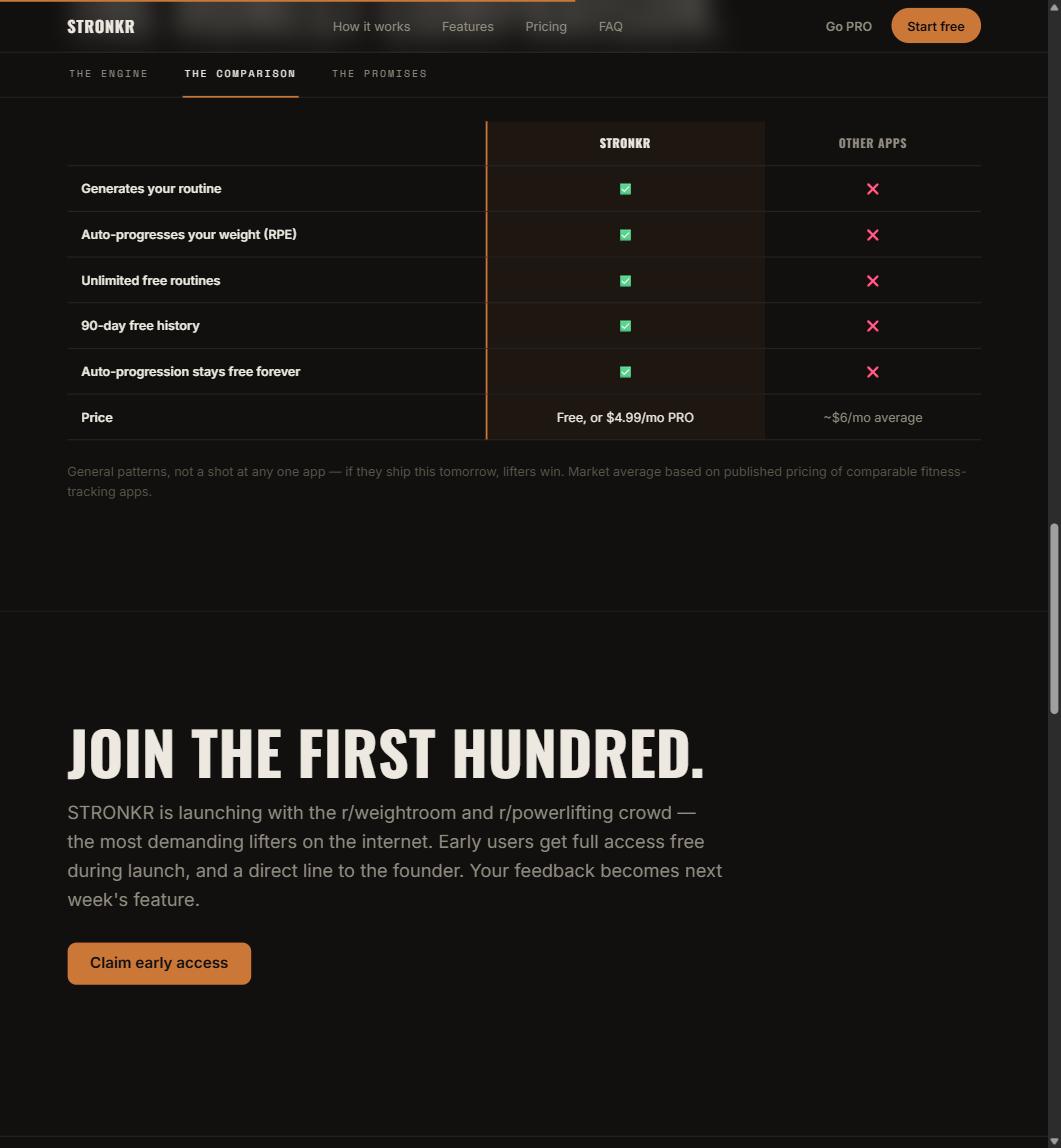
- Open the comparison section. The site carries a comparison table against other training apps. Read it knowing whose site it is on, a vendor’s own table is a claim, not a review.
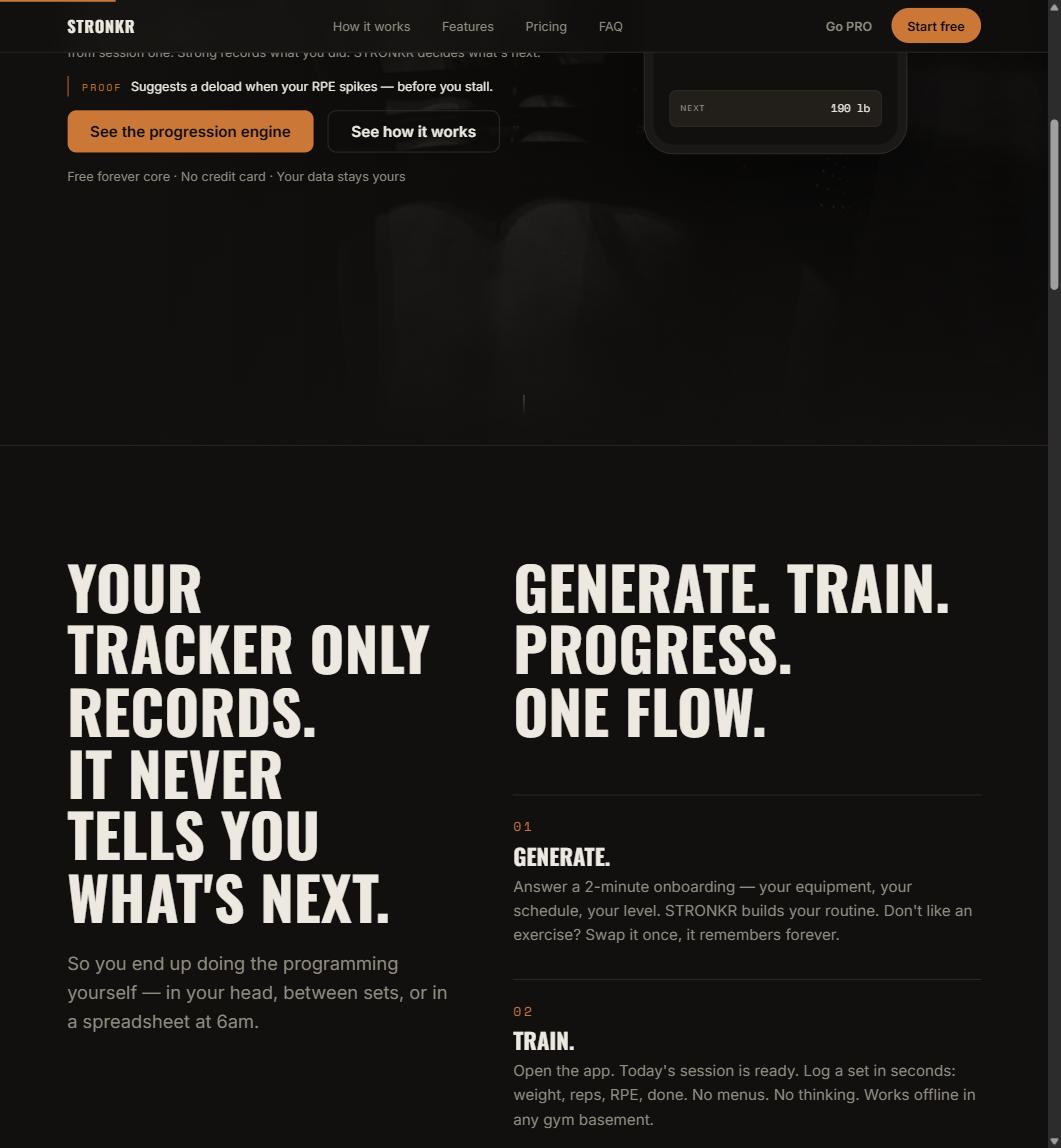
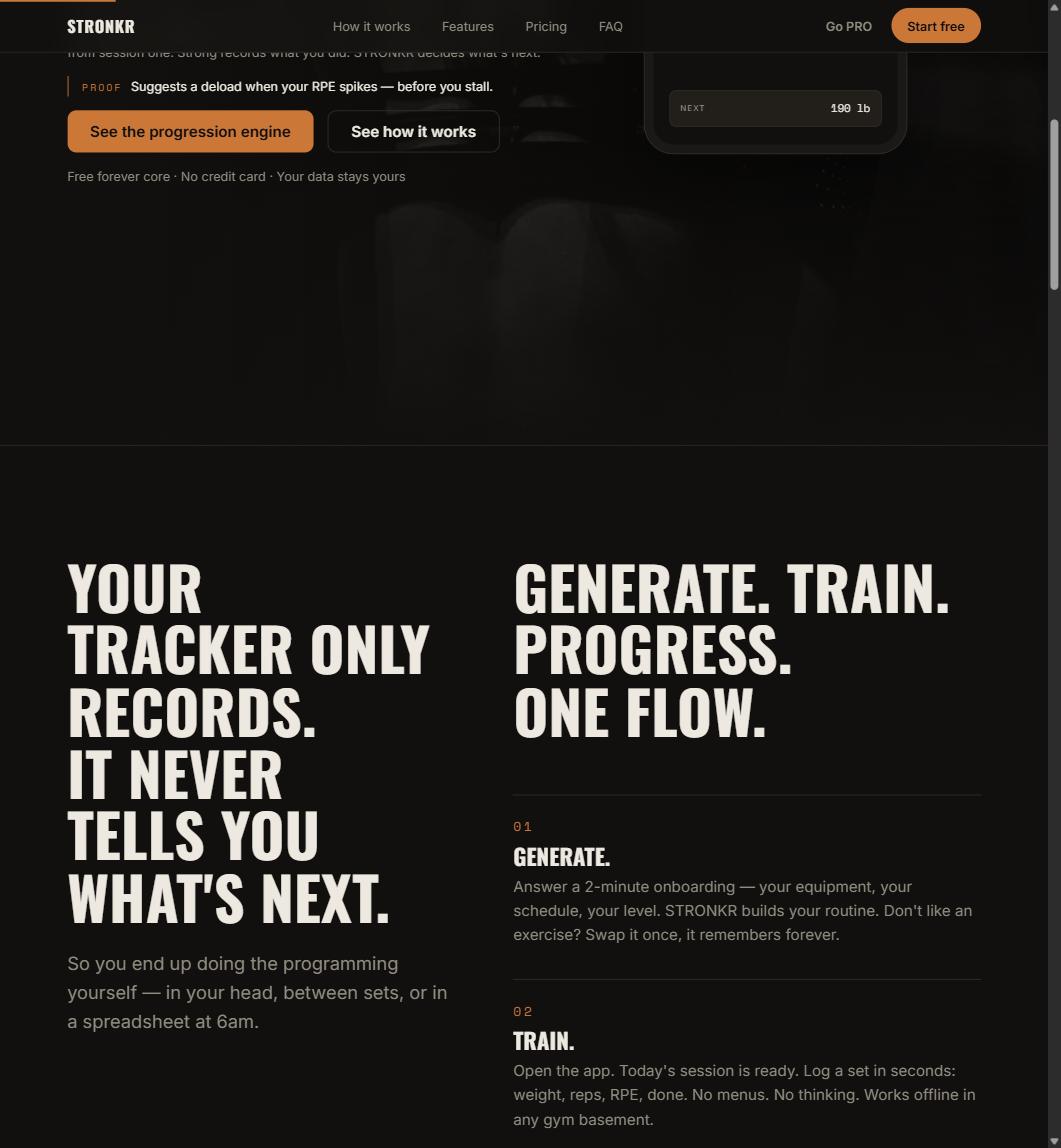
- Read the block above it. The homepage carries the line “YOUR TRACKER ONLY RECORDS. IT NEVER TELLS YOU WHAT’S NEXT.” That is the whole thesis, stated combatively.
- Find the section that draws the contrast. There is a dedicated section contrasting a tracker that only records with an engine that prescribes, which is the same distinction in longer form.
- Check the flow underneath. GENERATE, TRAIN, PROGRESS, laid out as a numbered sequence. The third step is the one a logger does not have.
- Look at the target mock. A
NEXT 190 lbtarget, which is the output of the engine rather than a record of the past. - Then verify it in the app. Rate a set 1 to 10 on RPE, complete it, and see what load comes back for your next session. That is the claim, testable in one session.
What are the incumbents genuinely good at?
Logging, which is not a small thing
Strong and Hevy are mature products that people use daily for years, which is a harder bar to clear than any feature list. Fast set entry, a deep exercise database, an interface that has been sanded down by a very large number of workouts. Nothing in this post is an argument that they are badly built.
Holding your history
This is the real moat, and it belongs to whoever you started with. Three years of logged sessions is a genuine asset. It is context for every decision you make, and it is the single strongest reason to stay put.
Being honest about their job
A logging app records. It is good at that. The complaint in this post is not that they log badly, it is that logging was never going to answer “what do I do on Thursday”, and no amount of charting turns a record into a prescription. That is a category boundary, not a bug.
A tracker is a filing cabinet with good search. That is useful. It is just not the thing you open a spreadsheet to compensate for.
What is the axis that actually separates them?
Recording answers “what did I do”
Your logger stores a history and renders it. Every decision about next week is still yours, made in your head between sets or in a Google Sheet at 6am. That second system is the tax, and it is the subject of the spreadsheet tax.
Prescribing answers “what do I do next”
Stronkr’s loop is: rate each set 1 to 10 on RPE after finishing it, and that rating sets the load for your next session, a target increase such as +5 lb, or Deload -10% when your ratings spike. The site’s proof line is that it suggests a deload before you stall. The mechanism is in how RPE auto-progression works, and the category split is argued in workout tracker vs programmer.
Check this for yourself rather than taking my word
I am describing Stronkr, which I can verify, and a category, which I can defend. I am not going to publish a feature list for someone else’s product or quote their pricing, because both change and neither is mine to characterise. If Strong or Hevy ships a prescriptive engine, that changes this comparison, go and read their own pages rather than trusting a competitor’s summary of them.
The short version of the test: keep the logger you like open, and let Stronkr pick one week of loads alongside it.
What does switching actually cost you?
Your history does not come with you
Stronkr has no import from Strong, Hevy, or anything else. There is no migration tooling, no export-import path documented, and no integration with wearables or health platforms. If someone tells you otherwise, they are inventing it. Your years of data stay in the app that has them.
Free history is capped at ninety days
On the free tier you get ninety days of lookback. Full history is a PRO line at $4.99 a month or $39.99 a year. Ninety days covers a training block, which is the window most people review, but if you are the kind of lifter who compares this October against two Octobers ago, know that going in.
The AI coach is not a reason to switch
It is listed on the pricing page as coming, which means it is not shipped. PRO buys first access to it, not the feature. Nobody at Stronkr reviews your training either. What exists is the engine, and the engine has to be enough on its own for a switch to make sense.
If a comparison post never lists what the product cannot do, it is not a comparison. It is an ad in a table.
So how should you actually try it?
Run both for one block
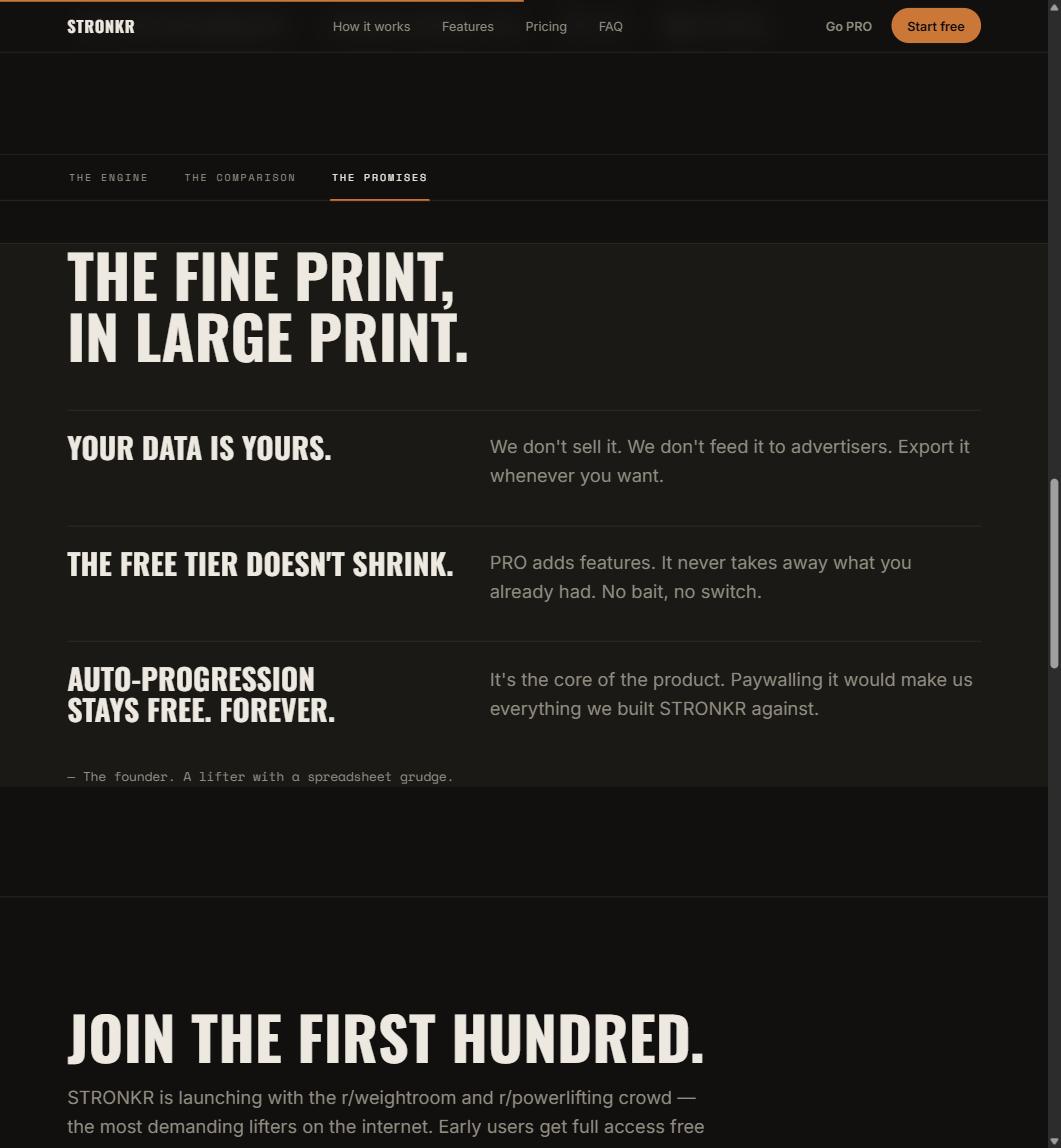
Migrating is the wrong frame, because there is nothing to migrate. Keep your logger for the archive you already trust, and let Stronkr decide the loads for one training block in parallel. The financial risk is zero: the engine is on the free tier, no credit card is taken at signup, and the commitment that the free tier never shrinks is written on the site rather than promised in a thread. That commitment is unpacked in what the free tier never shrinks commits us to.
Watch one behaviour, not a feature list
Does the spreadsheet stay closed. That is the whole test. If you are still doing arithmetic on Sunday night, Stronkr has not done its job and you should keep the logger you like. If the sheet stays closed for four weeks, the comparison has answered itself.
The test is not which app has the longer feature list. It is whether the spreadsheet stays closed for four weeks.
Decide at the end of the block
Then you are choosing between an archive you already own and a system that removes a chore. Reasonable people land on both sides of that, and running the two in parallel is the only way to make the choice with data instead of marketing.
Install it free at stronkr.com, keep your current tracker exactly where it is, and run one block with Stronkr picking the loads. If your spreadsheet does not go unopened, delete it and stay where you are.
Try auto-regulated training
Stronkr reads your RPE after every set and adjusts next session’s load for you. No spreadsheets, no guessing.
Start training with StronkrFrequently asked questions
Can Stronkr import my history from Strong or Hevy?
No. There is no migration tooling and no documented import, so your existing history stays in the app that holds it. If years of logged sets are the reason you would not switch, that is a legitimate reason and I am not going to talk you out of it with a feature that does not exist.
Is Stronkr better than Strong or Hevy?
They are built to do different jobs. Those apps are strong loggers with mature interfaces and, in your case, years of your data. Stronkr is built to decide the load for your next session from your RPE ratings. Compare them on that axis, not on a general ranking.
Can I run Stronkr alongside my current tracker?
Yes, and for a first block it is the sensible approach. Run Stronkr for the prescribing and keep your existing app for the archive you already trust. It costs nothing, since the free tier includes the progression engine and takes no credit card.
What does Stronkr not do that my tracker does?
It has no documented integrations with wearables or health platforms, no import from other trackers, and free history is capped at 90 days. There is also no AI coach yet, despite the pricing page listing first access to one. Those are the gaps worth knowing before you switch.
How should I actually test the difference?
Run one training block and watch a single behaviour: whether you still open a spreadsheet to work out next week's numbers. If the app is deciding loads, that habit stops. If you are still calculating by hand, the app is a logger regardless of what its marketing calls it.
Keep reading
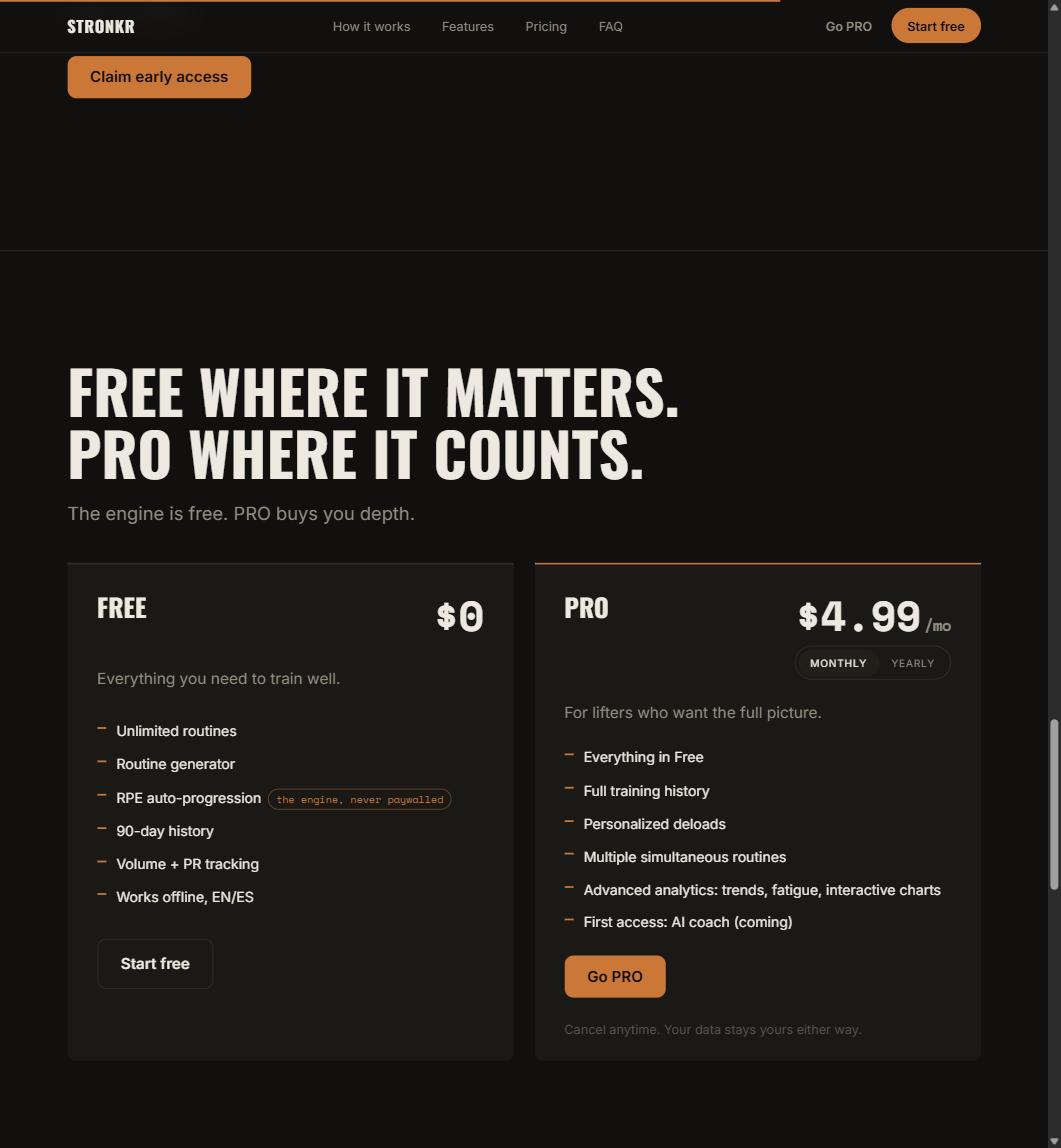
Free vs PRO: What $4.99 Actually Buys
An honest read of Stronkr pricing: what the free tier contains, what PRO adds at $4.99 a month, and why the AI coach on that list is not shipped yet.
Offline-First: Training in a Basement, Data That Stays Yours
An offline workout app that logs sets in a dead-signal basement, plus a plain reading of what 'your data stays yours' does and does not commit Stronkr to.
What 'The Free Tier Never Shrinks' Actually Commits Us To
A free workout app with no paywall is easy to say and easy to walk back. Here is what is in Stronkr's free tier and where the commitment is written down.