RPE for Progressive Overload: Why Lifters Who Log Everything Still Don't Progress

The Stronkr Founder Founder, Stronkr
9 min read

On this page
You have four hundred logged sessions. You can tell me what you benched on a Tuesday in March. And you are pressing roughly what you pressed a year ago.
RPE for progressive overload means using one extra number, how many reps you had left in the tank, to decide whether to add weight, hold, or back off, instead of guessing or following a fixed percentage that ignores how you actually feel that day. Weight and reps tell you what the bar did. RPE tells you what you had left, and that’s the number that actually drives the next decision. Rate every working set honestly on the 1 to 10 reps-in-reserve scale, read the trend over two to three weeks instead of one set, and apply four mechanical rules to what you find. That’s the whole system. The rest of this guide is how to do each part correctly.
What Does RPE Actually Mean in Strength Training?
The single most common mistake is treating RPE as a mood rating. The set was unpleasant, so it was an 8. You were tired going in, so it was a 9. That’s not what the number measures, and it’s why RPE has a reputation for being fussy or advanced when it’s actually the fastest skill to learn in strength training.
RPE Is a Reps-in-Reserve Estimate, Not a Feeling
Rate of Perceived Exertion, as it’s used in strength training, is a reps-in-reserve (RIR) scale. At the moment you rack the bar, you’re answering exactly one question: how many more reps could I have done with the same form? The RIR-based version of the scale was formalized for resistance training by sports scientist Michael Zourdos and colleagues, published in the Journal of Strength and Conditioning Research (2016), specifically because “hard” and “easy” mean something different to every lifter, while reps in reserve is something you can actually count.
The RPE Scale, Broken Down by Reps in Reserve
- 1 to 4, light. Six or more reps left. This is warm-up territory or genuine recovery work.
- 5 to 7, moderate. Three to five reps left. Useful for volume and technique, not for driving adaptation on a main lift.
- 8 to 9, hard. One to two reps left. This is where most productive work sits.
- 10, max. Nothing left. You could not have done another rep with that form.
An RPE 7 on a bad day still feels bad. It’s still a 7.
Notice the scale says nothing about how you felt about the set. That separation, effort measured and mood ignored, is what makes RPE usable as a training input instead of a diary entry.
Why Rounding Your RPE Up or Down Wrecks Your Progress
Once you know what the number means, the next failure point is honesty. There’s a strong pull toward rounding up: a hard set feels like it deserves a big number, and a big number feels like a productive training week. Resist it. The direction you round determines whether your next load is right or wrong.
What Inflating Your RPE Costs You
If you log RPE 8 on a set that was really a 6, any progression system, whether yours, a coach’s, or an algorithm’s, reads that as “close to the ceiling” and moves conservatively. You leave load on the table for weeks, and nothing in the log tells you why progress feels slow, because on paper you were already training hard.
What Deflating Your RPE Costs You
Round the other way, logging 8 on something that was genuinely a 9.5, and the system adds weight you cannot absorb. You hit a session you can’t complete, then another, and you call it a plateau when it was really a bookkeeping error compounding over a month.
The Honest Number, Not the Impressive One
The honest number is not the modest number or the impressive one. It’s the one that makes the next decision correct.
That’s the entire standard to hold yourself to. Not “what RPE sounds right for how hard I trained today,” but what RPE gets you the right weight next time.
How Do You Rate RPE Accurately, Set by Set?
Rate it before you sit down
Rate immediately. Before you sit down, before you check your phone, before the next set changes your memory of this one.
The rating belongs to the set that just happened, not the workout as a whole. Four habits make the number reliable enough to act on.
Ask the Specific Question, Not “How Did That Feel”
Ask “how many more, same form?” instead. If the honest answer is “one, maybe two,” that’s an 8 or a 9. If you genuinely don’t know, you were probably at 7 or below. At the top of the scale, you know.
Ignore the Warm-Up Fatigue
Fatigue from earlier sets is already priced into the set you’re rating. You’re not rating how tired you are for the day; you’re rating this set, in the state your body was actually in when you did it.
Count Form Failure as Failure
If rep six would have been a different lift, with hips shooting up, the bar drifting forward, or a knee caving in, then rep five was your last clean rep. That’s a 10 for that set, whatever your legs technically had left in them.
Be Consistent Before You’re Precise
A scale you apply the same way every week beats a scale that’s theoretically perfect but drifts. This is also where the skill measurably improves with practice. In Zourdos et al.’s original validation study, experienced lifters showed a much tighter relationship between bar velocity and RPE (r = -0.88) than novices did (r = -0.77), meaning trained lifters read their own effort more consistently. RIR accuracy is a trained skill, not a talent you either have or don’t.
How RPE Trends Reveal a Stall Before You Miss a Rep
Once you rate honestly for three or four weeks, something appears that a weight-and-reps log can never show you on its own: a trend.
Rising RPE at a Fixed Load Is Your Earliest Warning
Take 225 lb for three sets of five. Week one you rate it 7. Week two, 7.5. Week three, 8.5. Week four, 9. Nothing in a plain log has changed. Same weight, same reps, same sets, four identical rows. But the cost of that work climbed steadily, and that’s the clearest stall signal in strength training. It shows up before the missed rep, usually two to three weeks before.
| Week | Load | Sets × reps | RPE | What a plain log shows |
|---|---|---|---|---|
| 1 | 225 lb | 3 × 5 | 7 | Identical row |
| 2 | 225 lb | 3 × 5 | 7.5 | Identical row |
| 3 | 225 lb | 3 × 5 | 8.5 | Identical row |
| 4 | 225 lb | 3 × 5 | 9 | Identical row |
Falling RPE at a Fixed Load Means You’re Under-Loaded
Read the trend the other direction and it’s just as useful. Same load, RPE falling from 8 to 7 to 6.5? You’re under-loaded and have been for a couple of weeks. That’s not recovery, that’s a wasted training block.
Why Autoregulation Beats a Fixed Percentage
Your ceiling moves with sleep, work, food, stress, and how the last session went. RPE is the cheapest possible measurement of where the ceiling is today.
This is the core argument for autoregulation over rigid percentage programming, and it’s not just a training philosophy. It’s a documented approach in the sports science literature. Eric Helms and colleagues, writing in the Strength and Conditioning Journal (2016), describe the RIR-based scale as a method that “adjusts loads automatically to match athlete capabilities… and may more accurately gauge intensity at near-limit loads” compared to a fixed percentage decided weeks in advance. A follow-up comparison by Helms and colleagues in Frontiers in Physiology (2018) tested RPE-based loading directly against matched percentage-based programming in trained lifters, the kind of head-to-head evidence that separates autoregulation from a training fad.
How to Use RPE for Progressive Overload Every Week
Reading the trend is only half the system. The other half is mechanical, which is exactly why it’s tedious to do by hand every week.
Four Rules for Turning RPE Into Next Week’s Load
The four rules
- Set came in below your target RPE? The load was too light. Add weight next session.
- Set landed on target? The prescription was right. Progress on your normal schedule.
- Set came in above target, once? Hold the load, and look at sleep and food before you touch the weight.
- Set came in above target repeatedly, or RPE is climbing at a fixed load? Deload. Drop the working weight, keep the movement pattern, rebuild.
Why Lifters Who Log Everything Still Progress Nothing
Four rules, applied per exercise, across every lift in your program, every week, tracking the trend rather than the last data point. That’s a spreadsheet, and it’s the reason so many lifters who log every single set still don’t progress: they collect the input and never run the calculation.
The data was never the bottleneck. The arithmetic was.
How Stronkr Automates RPE-Based Progression
When I built Stronkr’s auto-progression engine, this was the exact job I was trying to kill for myself: the spreadsheet running parallel to my tracking app, recalculating next week’s weight from last week’s RPE by hand, set by set, lift by lift.
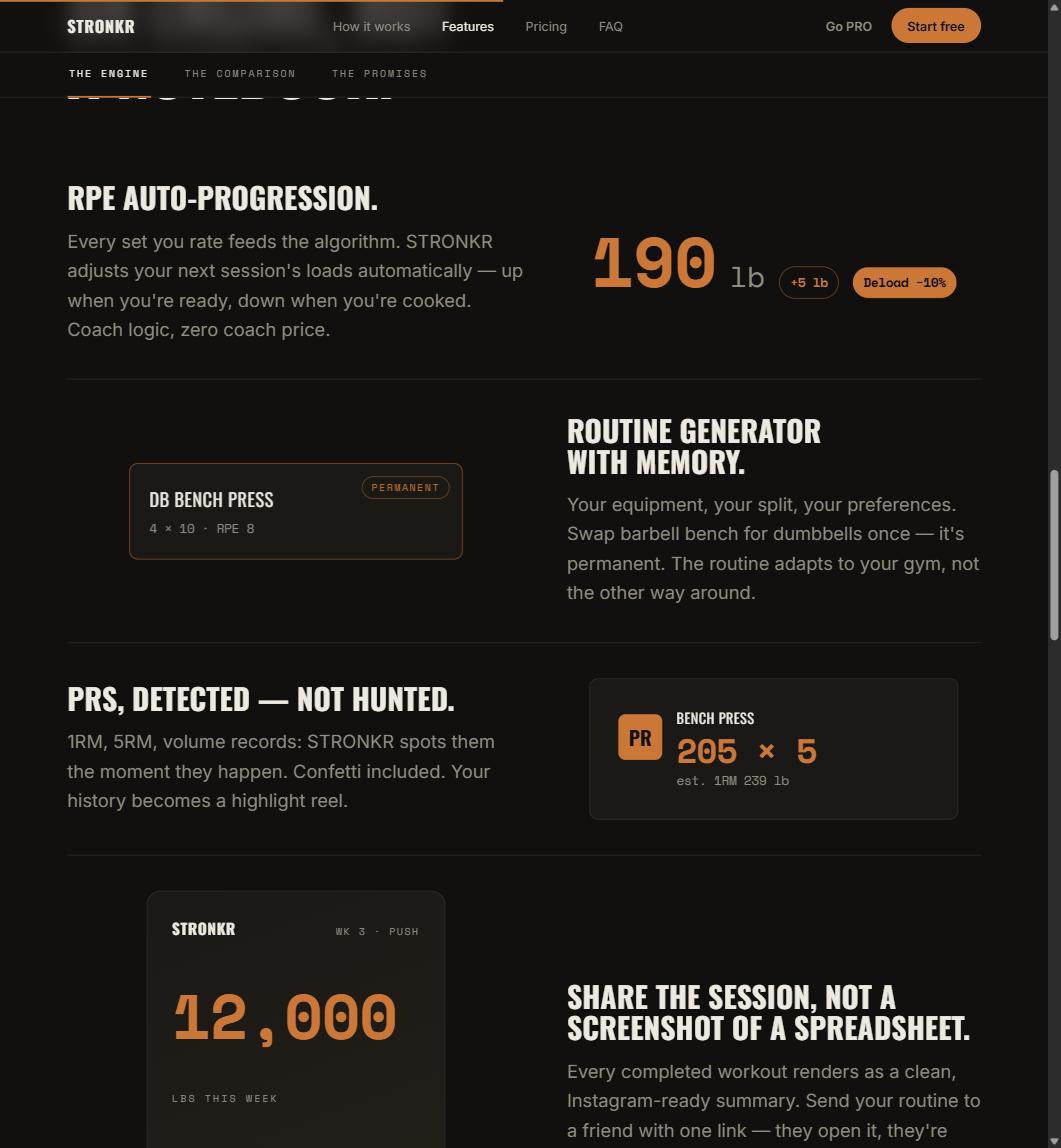
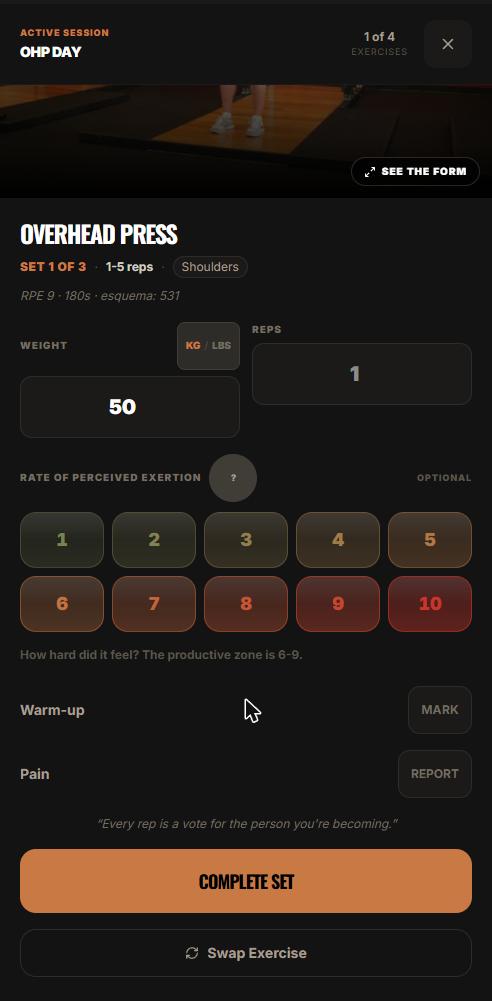
You tap a number after each set. It takes about a second, and the reference scale is one tap away. Every rating feeds the engine. Your next session’s loads arrive already calculated: add weight when you’re below target, hold when you’re on it, or flag a deload when the trend says you’re redlining. Those are the same four rules above, running automatically in the background of every session instead of in a spreadsheet next to it.
Compare Stronkr vs. Strong Both log the set. Only one reads the RPE trend and decides the next load for you. Side by side on what each app actually does with the number.If you want to see those four rules running on your own numbers instead of taking our word for it, the RPE auto-progression engine is in the free tier. No trial, no card required.
You’re not doing the arithmetic. You’re not maintaining a sheet next to the app. You’re doing the one part only you can do, rating the set honestly, and the engine does the part that’s arithmetic. Every feature that ships, including this one, is logged in public on Stronkr’s changelog, so the claim is checkable, not just marketing copy.
Start free at stronkr.com. The site’s own pricing line puts it bluntly: “The engine is free. PRO buys you depth.” Two minutes of onboarding, and your next session is already calculated.
Try auto-regulated training
Stronkr reads your RPE after every set and adjusts next session’s load for you. No spreadsheets, no guessing.
Start training with StronkrFrequently asked questions
What is a good RPE for building strength?
Most productive strength work sits at RPE 7 to 9, which is one to three reps in reserve. RPE 10 (true failure) works occasionally but taxes recovery too much to run every session. If you're consistently below RPE 6 on your main lifts, the load is too light to drive adaptation.
What's the difference between RPE and RIR?
RIR (reps in reserve) is the count itself: how many more reps you could do. RPE is the 1 to 10 scale built around that count. RPE 10 means zero reps in reserve, RPE 8 means about two. Most lifting apps, Stronkr included, use the terms interchangeably.
Can beginners use RPE, or is it only for advanced lifters?
Beginners can start using RPE in week one. The question behind it ("how many more reps, same form?") takes one session to learn. What takes longer is estimation accuracy, and that improves with reps under the bar, not with a certification.
How accurate is RPE, really? Can you trust a feeling?
RPE isn't a feeling, it's an estimate of reps in reserve, and it isn't arbitrary. Research on the RIR-based scale found bar velocity drops in a strong, predictable relationship with rising RPE. That's precise enough to drive real programming decisions.
Why does my RPE keep climbing at the same weight?
Rising RPE at a fixed load is usually the earliest sign of a stall. The weight now costs more than it used to, even though the number on the bar hasn't moved. It typically shows up two to three weeks before you actually miss a rep.
How is Stronkr different from just logging RPE in Strong or Hevy?
Strong and Hevy record the number; neither uses it to decide your next load. Stronkr reads your RPE trend after every set and calculates the next session's weight automatically, whether that means add, hold, or deload, so you're not running that math in a spreadsheet on the side.
Keep reading
Autoregulation for Intermediate Lifters: A Field Guide
Autoregulation training loads the lifter you are today, not the one the spreadsheet predicted. How RPE handles bad sleep, stress and travel weeks.
Evidence-Based, Not AI-Improvised: Where Stronkr's Programming Comes From
An evidence-based workout app should tell you where its logic comes from. Stronkr's progression follows published autoregulation practice, not a chatbot.
How to Rate Your Sets Accurately (and Get Better at It)
How to use RPE without guessing: rate immediately, ask how many reps you had left, and expect to be wrong early. A calibration guide for lifters.